

Affiliate disclosure: This article contains paid links to Amazon and Walmart. As an Amazon Associate, I earn from qualifying purchases. We may also earn a commission from qualifying Walmart purchases, at no extra cost to you.
Quick answer: A small dog pet gate needs openings your dog cannot squeeze through, enough height for your dog’s behavior, and a mounting system suited to the location. A low gate can suit a calm dog on a level floor; an energetic jumper needs a different barrier. Check the gaps beside the frame and under the gate as carefully as the bars.
Start with fit, then compare the total checkout cost.
View Carlson on AmazonCompare Walmart Listings
Walmart buttons open product searches. Match the exact model and size before comparing prices. Live prices, seller availability and delivery charges can change.
A gate that works for a large dog can leave a surprisingly easy escape route for a puppy or toy breed. The height may look impressive while a gap beside the wall is wide enough for the smaller dog. On the other hand, a very low barrier marketed for small dogs may do little for an athletic terrier. Shopping by breed size alone misses both problems.
This guide focuses on everyday indoor room separation for small dogs. It compares two identifiable products and explains when to choose a different design. It is based on manufacturer specifications and instructions, rather than hands-on testing. Neither option is a universal recommendation, and neither should be treated as an escape-proof barrier or a substitute for supervision.
Small Dog Pet Gate: Two Options at a Glance
| Option | Published fit | Design | Main decision |
|---|---|---|---|
| Carlson Lil Tuffy, model 0618 | 18 inches high; 22–38 inches wide | Metal, expandable, pressure mounted, small pet door | Consider for a calm dog only after checking the bar spacing and closed pet door |
| North States MyPet Paws Portable Petgate | 23 inches high; 26–40 inches wide | Portable pressure barrier | Consider for a level-floor opening; check the pattern openings and edge gaps |
| A taller walk-through design | Depends on exact model | Adult access door with latch | Investigate when a low barrier or repeated stepping over is unsuitable |
Dimensions describe the manufacturer’s listed products, not every listing with a similar title. Retailers may carry older versions or different configurations. Use the model number, packaging and supplied manual to resolve any mismatch before installation.
1. Carlson Lil Tuffy: A Low Metal Option

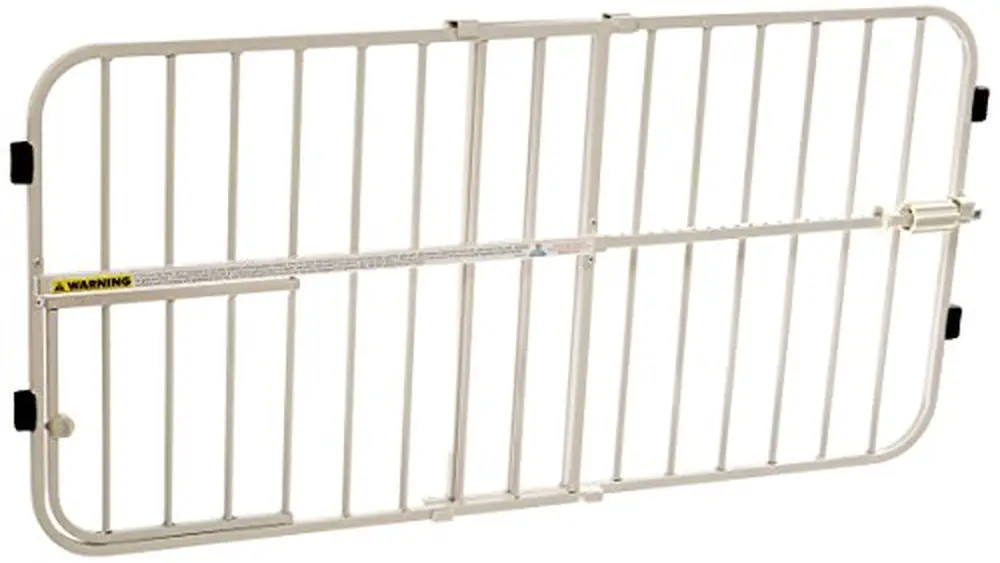
Carlson lists model 0618 as an 18-inch metal gate for 22–38-inch openings. Its listed bar gaps are 2–2.5 inches, and the small pet door measures 7.5 by 7.75 inches. No extensions are listed for this model.
Fit consideration: That small door is useful only when you deliberately want a pet to pass. Keep it secured when it would defeat your separation plan. The low height and bar gaps also make this a conditional option for a small dog, rather than a default choice for every puppy.
2. MyPet Paws Portable: A Higher Removable Barrier

North States lists the Paws Portable Petgate at 23 inches high for openings from 26 to 40 inches. It offers more height than the low Carlson option, but still needs an individual fit check.
The manufacturer’s instructions prohibit top-of-stairs use and say to stop using it when a pet can climb over or dislodge it. A household that regularly crosses the doorway may prefer to investigate a walk-through design instead of removing or stepping over a panel.
Measure the Opening Before Choosing a Gate
Measure where the gate’s mounting points will actually touch the frame. A measurement taken above a baseboard may not describe the space at the lower pressure pads. Write down the width at the bottom, middle and upper mounting area, and note any difference. Door trim, quarter-round molding and uneven walls can affect alignment even when the nominal doorway width appears suitable.
Also check the surrounding space. Does the room door need to close? Is there a floor vent, a sliding door track, a rug edge or a cabinet handle nearby? Can the gate sit square without twisting its frame? A product that technically spans the opening may still be awkward or impossible to install correctly in that location.
For an expandable model, read the supported combinations of panels and extensions. The advertised maximum is not permission to invent a configuration. Do not stretch pressure bolts beyond their documented limit, join unrelated extension kits, or fill a shortfall with a block of wood. If your measurement falls outside the specified range, choose another gate or contact the manufacturer about an approved solution.
Make a simple fit worksheet
- Record the clear opening at every mounting height.
- Photograph the baseboards and both sides of the doorway.
- Note the floor surface and nearby door swing.
- List who will cross the barrier and how often.
- Compare those details with the exact model manual before ordering.
Keep the measurements with your order confirmation. They help you recognize a wrong size or variant when the box arrives and make a return decision before the return window closes.
Check Every Escape Gap, Not Just the Main Bars
The important openings include the spaces between bars, the gap under the gate, the edges beside the wall and any opening around the latch. A decorative cutout can also matter. Do not assume that a product labeled for small pets has sufficiently narrow spaces for your individual dog.
Ask the seller or manufacturer for measurements that are missing from the listing. Product photos can hide edge gaps, and perspective makes distances difficult to judge. If the answer is unavailable, treat the fit as unresolved. Choose an option with clearer specifications rather than relying on the dog’s weight or a reviewer’s breed description.
Never push your dog’s head through an opening to test it. During a supervised introduction, watch from nearby for squeezing, pawing, chewing or attempts to put the head through a gap. Stop the trial if the dog can partially enter an opening or appears at risk of getting caught. A gate should prevent the attempt, not leave the dog wedged halfway through.
Avoid improvised mesh, cable ties, fabric or extra bars as a quick fix unless the manufacturer explicitly approves the modification. Add-ons can change the latch action or introduce loose parts and chewing hazards. Selecting a better-fitting barrier is a more reliable purchase decision than planning a repair before the product has arrived.
Low Step-Over or Walk-Through Gate?
A low panel can be convenient in a quiet doorway that adults rarely cross. Its usefulness depends on the dog’s behavior and the people using the room. A small dog that jumps, climbs or charges a barrier may need a different arrangement even if another dog of the same size stays behind it calmly.
Think about the human trip risk as well. Carrying laundry, walking in dim light or using a mobility aid changes how practical a step-over panel feels. Do not select a short gate purely because the listing calls it easy to step over. If crossing is uncomfortable, choose a suitable access-door design or a different layout.
A walk-through gate also deserves inspection. Check the clear passage width, how the latch opens, whether the door needs manual closure and whether a threshold creates an obstacle. Practice the mechanism before relying on it. A gate left open because it is inconvenient provides little benefit, regardless of its advertised height.
For related layouts, see our narrow pet gate guide and walk-through gate with cat door guide. A cat opening can allow the small dog through too, so mixed-pet households need an especially careful fit check.
Mounting and Location: Read the Exact Manual
Pressure mounting does not automatically mean that every installation is entirely free of screws. Some designs require secured wall cups or other retaining hardware. Follow the manual for the actual model and location, including the hardware it specifies. Rubber pads may reduce scuffs, but they do not guarantee that paint, plaster or trim will remain unmarked.
Use a level-floor doorway for the room-separation options discussed here. Do not put either option at the top of stairs. A stair barrier needs a product explicitly approved for that use and installed exactly as instructed. A convenient portable room gate is not a substitute for that decision. If you cannot confirm stair suitability, leave that application unresolved until you can.
Freestanding gates have their own limits. They can be useful for a dog that respects a visible boundary, but a dog may push around an edge or move the panels. Avoid choosing one merely because it avoids drilling. Where anchoring is needed, investigate an approved mounting solution. Our wall mount pet gate guide explains the questions to ask about fixed installations.
Amazon vs Walmart: Compare the Same Gate
A useful price comparison begins with product identity. Match the brand, model, height, width range, color, included extensions and item condition. Similar names can refer to different sizes, and a cheaper listing may omit the hardware that another package includes. An accessory is not equivalent to a complete gate.
| Check | Amazon | Walmart |
|---|---|---|
| Exact version | Read selected size and model | Match the same specifications |
| Seller | Check sold-by and fulfilled-by details | Check retailer or marketplace seller |
| Total cost | Include shipping and required hardware | Include shipping and required hardware |
| Returns | Read the terms for that listing | Read the terms for that seller |
| Delivery | Use the estimate for your address | Check delivery or pickup availability |
We have not established a live price winner. The buttons let you check the offers available to you; they are not a claim that a specific retailer currently has stock or the lowest price. Shipping, tax, membership conditions and returns can outweigh a small difference in the displayed item price.
If you are shopping around Black Friday, save the exact model and your current checkout total before the sale. Compare that baseline with the later offer, including any extra hardware. Avoid buying a poor fit simply because the discount looks large. A correct size with usable returns is more valuable than a low advertised price on a gate you cannot install.
Introduce the Gate and Recheck It Regularly
Prepare a comfortable area with the resources your dog needs before closing the gate. Begin with short supervised periods while you are nearby. Reward calm behavior and give the dog time to understand the boundary. Do not leave the dog to discover an unsuitable barrier through repeated jumping or pushing.
Check alignment, mounting points and latch engagement according to the manual. Reinspect after moving the gate, cleaning around it or noticing an impact. Stop using damaged parts or a panel that will not lock as intended. Keep the instructions and model information so replacement parts can be matched correctly.
A growing puppy may outgrow the original arrangement. Reassess gaps, height and behavior as the dog develops. If a dog repeatedly tries to climb, panics when separated or hurts itself at the barrier, stop relying on that setup and seek appropriate help. A stronger purchase alone may not resolve the reason for the behavior.
Frequently Asked Questions
What height should a small dog pet gate be?
There is no single height for every small dog. Evaluate jumping and climbing behavior as well as size. If your dog can clear or dislodge a low gate, stop using it as containment and investigate a more suitable barrier.
Can a small dog get through a cat door?
Yes. A pet door does not identify species. Compare the opening with your separation needs and keep it secured when the dog could otherwise pass through.
Is a pressure gate completely damage-free?
Not necessarily. Pressure can mark surfaces, and some installations require fixed cups or hardware. Read the instructions and check your wall finish before installation.
Can I use these options at the top of stairs?
No. Choose a gate explicitly approved for that location and use the required mounting method. The portable room barriers in this comparison are not recommendations for a stair-top installation.
Which store has the better price?
Check the linked listings for the same model, then compare the full checkout cost and return terms. We have not verified a current lowest-price retailer.
Choose the Fit Before the Offer
Start with your doorway measurements, your dog’s escape behavior and the gaps in the exact product. Then decide whether a removable panel or an access-door design suits the household. Compare retailer offers only after those requirements are met. That order keeps the buying decision focused on a barrier you can actually use.
Ready to compare? Confirm the exact model, included hardware and return policy before checkout.
About the author: Amelia Miller
Amelia writes PetPotLuck buying guides to help pet owners compare product fit, installation requirements and purchase options. This article is a specification-based guide; it does not claim hands-on testing or guaranteed containment.
Editorial check: October 26, 2026. Confirm the supplied manual and current listing before purchase.