

Affiliate disclosure: As an Amazon Associate, we earn from qualifying purchases. We may also earn a commission through other retailer links, at no extra cost to you.
A separate route for your cat, an easier doorway for you
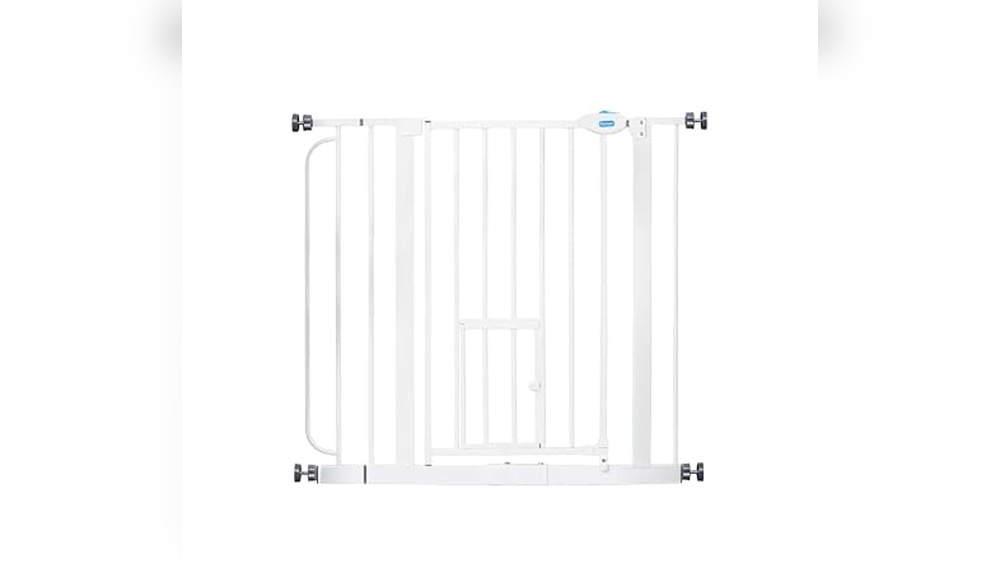
A walk through pet gate with cat door can separate a dog from a cat’s food or litter area while leaving adults a normal way through. Start with three measurements: your opening, the cat’s usable passage, and the width of the human walk-through.
Buttons open retailer search results. Match the model, size, included extensions and seller before comparing totals. Prices and availability can change.
Quick answer: Choose this style when your cat can comfortably use the small opening and your dog cannot follow. A cat door is a size filter, not an automatic dog-proof feature. For a busy hallway, the adult door’s width and the bottom threshold deserve as much attention as the gate’s overall dimensions.
This guide focuses on everyday access between rooms. For a taller barrier, see our tall pet gate with cat door guide. For an unusually broad opening, start with our extra-wide walk-through gate guide. Choosing the right category first can save you from buying extensions that still do not solve your problem.
Who should consider a gate with a cat door?
The most useful arrangement is a household with a larger dog and a smaller cat who needs access to a quiet room. A gate may help organize feeding areas, keep a dog away from a litter box, or provide a visible boundary during supervised routines. The small passage should lead somewhere the cat can enter and leave without being cornered.
It is less useful when both animals are similar in size. A small dog may fit through the opening just as easily as a cat. A determined dog may also push, climb or jump instead of respecting the barrier. If keeping the pets apart is essential and either animal defeats the gate, use a more secure separation method appropriate to your situation.
Do not assume a pet gate is a child safety gate. A small pet opening changes who can get through. If children also use the space, check the exact product’s intended use, warnings and installation instructions rather than relying on a retailer category label.
Two Carlson configurations worth checking
How we selected these: This is a research-based buying guide, not a hands-on test. We checked the manufacturer’s model specifications and focused on two different opening configurations. We do not give either model a universal “best” rating or claim that we tested its latch, strength or long-term durability.
1. Carlson Extra Wide Walk-Thru — standard doorway option
The manufacturer lists the 0930 B configuration at 30 inches tall, with a 16.5-inch adult passage and a 7.5 × 7.75-inch small pet opening. Its listed fit intervals are 29–32 inches without the extension and 34–36.5 inches with the included 4-inch extension. The 32–34-inch gap matters.
Consider it if: your measured opening matches a supported configuration and the adult passage suits your daily routine. Check first: color and retailer listings can use different model suffixes; confirm the exact unit’s manual rather than assuming every similarly named gate includes the same parts.
2. Carlson 44-inch Extra Wide Walk-Thru — wider configuration
Carlson lists model 0937 PW with 4-inch and 6-inch extensions. Its supported intervals are 29–32, 34–36.5, 35.5–38.5, and 40–44 inches, depending on configuration. It is 30 inches tall and lists the same 16.5-inch adult passage and 7.5 × 7.75-inch small pet opening.
Consider it if: your doorway needs the wider kit. Check first: the larger overall span does not mean a wider adult door, and the manufacturer identifies unsupported gaps. Compare the complete kit instead of treating the headline width as continuous adjustment.
Comparison: what changes and what stays the same?
| Decision point | 0930 B configuration | 0937 PW configuration |
|---|---|---|
| Opening fit | 29–32 or 34–36.5 inches | 29–32, 34–36.5, 35.5–38.5 or 40–44 inches |
| Included extensions | 4-inch | 4-inch and 6-inch |
| Adult passage | 16.5 inches | 16.5 inches |
| Height | 30 inches | 30 inches |
| Shopping priority | Correct doorway interval | Correct interval and complete wider kit |
| Retailer price | Check current total | Check current total |
These are manufacturer-listed configurations, not measurements we took. At a range boundary, consult the model’s installation chart before ordering. Do not round your doorway measurement down to make a product appear compatible.
Measure the doorway for the way you actually use it
1. Measure at the mounting surfaces
Measure the clear opening where the gate’s contact points will sit. A baseboard can make the bottom narrower than the top. Decorative trim may also leave an uneven surface. Record both measurements and note where the wall cups or mounting hardware would go. A single measurement taken at chest height may miss the part that prevents proper installation.
Take a photo of the area and keep your measurements beside the product’s configuration chart. If the opening is tapered or has a banister on one side, ask the manufacturer about approved installation parts. Do not improvise a stack of loose spacers to make an unsuitable gate reach the wall.
2. Check the adult passage with your normal routine
Walk through the doorway while carrying what you usually carry: a laundry basket, pet-food container or groceries. The gate frame can fit a broad doorway while leaving a noticeably narrower door inside it. Think about the space needed to approach the latch and whether the door will swing into furniture, a cabinet or another door.
Also consider who uses the route. A narrow passage and raised threshold may be inconvenient for someone with limited mobility. Compare the actual clear opening with their needs rather than judging from a wide-angle product photo. If a different mounting style would create a more practical route, compare it before buying.
3. Plan around the bottom threshold
Many framed walk-through designs leave a bar across the floor. Treat it as part of the purchase decision. Look at lighting, rugs, foot traffic and whether people tend to hurry through this area. A gate that is convenient for pets can still be awkward in a frequently used passage.
Avoid solving the inconvenience by routinely stepping over the whole gate. If the latch is so awkward that everyone ignores it, choose a layout that better matches your household. Everyday usability helps a boundary stay in use.
Will the cat door keep your dog out?
Measure the cat’s comfortable passage needs and compare them with the opening’s usable dimensions. An opening that looks large in a photo may be awkward for a broad-bodied cat. Conversely, your smaller dog may fit through a passage advertised for cats. Breed labels alone do not answer either question.
Before leaving the arrangement unattended, observe both animals with the gate properly installed. Allow the cat to investigate without forcing it through. Watch whether the dog follows, pushes at the small door, or tries to reach through. Stop using the arrangement if either animal becomes trapped, distressed or able to defeat the barrier.
Keep the area beyond the small opening clear. A litter mat, food bowl or storage box should not make the cat squeeze out directly into an obstacle. The aim is a comfortable route that works in both directions. For a nervous cat, a gate that exposes it to constant staring or chasing may not provide the quiet space you intended.

Pressure mounting and installation: read the exact manual
“Pressure mounted” does not automatically mean that every installation is entirely free of screws. A manufacturer may specify wall cups or other hardware for the intended setup. Review the included instructions before deciding that the gate is suitable for a rental home. Get permission for permanent fixings where needed.
For this guide, consider ordinary interior doorways or other manufacturer-approved locations. Do not select a pressure-mounted pet gate for the top of stairs based on a marketing photo. A fall-hazard location needs a product explicitly approved for that placement and installation exactly as directed. A pet gate also should not be treated as a substitute for supervision or a secure exterior door.
After assembly, check that the main latch engages and the small door works as intended. Keep the manual and model number so you can identify replacement parts. If a mounting point moves, the latch stops aligning or a part becomes damaged, stop relying on the gate until the problem is resolved according to the maker’s instructions.
Amazon vs Walmart: compare the complete purchase
We have not verified a current checkout price for either retailer, so there is no invented “cheapest store” claim here. Use the buttons to compare available listings and calculate the total for the exact configuration you need. A lower displayed price can be misleading if it excludes a required extension or comes from a different seller.
| Compare | What to check at both stores |
|---|---|
| Exact model | Match model number, color, height and kit contents. |
| Delivered total | Include shipping, taxes and any necessary approved accessories. |
| Seller | Check who sells and ships the item, especially marketplace listings. |
| Returns | Review the current return window, conditions and possible return costs. |
| Timing | Compare the delivery estimate for your ZIP code. |
A practical approach is to make a short shopping note: doorway measurements, supported interval, model number and included extensions. Open both stores, find matching listings, then compare final totals. If only one store has the correct configuration, a cheaper incompatible gate is not a useful saving.
Common mistakes to avoid
- Treating the width range as continuous: extension combinations can leave unsupported intervals.
- Confusing overall width with passage width: a wider kit can still have the same human door.
- Assuming cat-only access: a small dog may fit through too.
- Buying for appearance alone: mounting surfaces, threshold placement and latch access determine everyday usefulness.
- Expecting universal containment: jumping, climbing and pushing behavior can defeat a gate that suits a calmer pet.
Frequently asked questions
Can a small dog get through the cat door?
Yes, depending on the dog and the usable opening. Compare actual dimensions and observe your pets with the installed gate before relying on it for separation.
Does a 44-inch gate provide a wider adult doorway?
Not necessarily. The Carlson configurations discussed here both list a 16.5-inch adult passage. The wider kit expands the overall span.
Can I install one without drilling?
Check the exact manual and location requirements. Pressure mounting does not guarantee that required wall cups or other parts can be installed without screws.
Will this keep my cat contained?
A gate with an open cat door is intended to allow small-pet access. Even with that door closed, a cat may climb, jump or pass through other gaps. Do not assume it will provide secure cat containment.
Which store has the lowest price?
Compare matching live listings at Amazon and Walmart. We have not confirmed a current checkout-price winner; seller, shipping and included extensions can change the result.
Choose fit first, then compare the two stores
For this purchase, the strongest starting point is a compatible opening configuration and a comfortable route for both people and the cat. Shortlist the standard kit if its supported interval matches your doorway; compare the wider kit if you need its extension combinations. Move on to a different design if either pet can defeat it or the threshold makes the route impractical.