

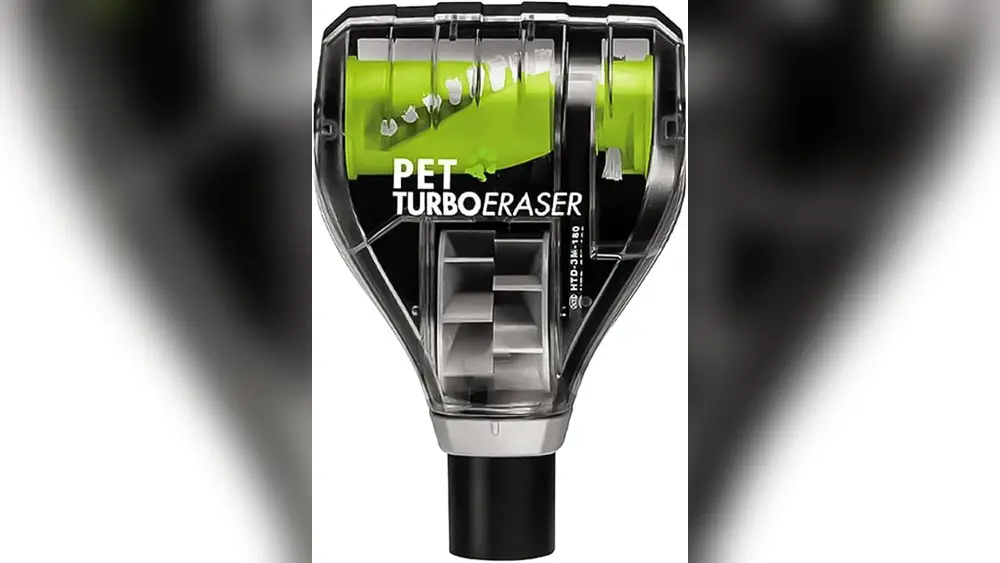
If your vacuum turbo brush is not spinning, first check for hair wrapped around the roller and weak airflow at the hose. If the brush spins above the couch but stops as soon as it touches the fabric, try a lighter pass on a firm cushion. If suction is strong and the clean roller still fails on a suitable surface, check the attachment’s manual for service options or match the exact replacement part.
This guide covers the small attachment you connect to a vacuum hose or wand to pick up pet hair on sofas, carpeted stairs and car seats. If you are troubleshooting the large floor head of an upright vacuum, use its floor-head instructions. Those heads can have different switches, belts and overload protection.
Match the symptom to the first check
| What you notice | Check first | What the result suggests |
|---|---|---|
| Weak pickup with both the turbo brush and a plain nozzle | Bag or bin, filters, hose and wand | The vacuum or air path needs attention before you diagnose the brush. |
| Normal suction with a plain nozzle but little pickup with the turbo brush | Roller wrap and nozzle throat | The restriction or drag may be inside the tool. |
| Roller spins in the air and stops on contact | Fabric, downward pressure and airflow | The surface may be dragging on the roller or sealing off the intake. |
| Tool works when connected directly but slows with the wand or adapter | Wand obstruction, adapter fit and joints | An extra connector or extension may be introducing a leak or restriction. |
| Clean roller still stalls with good suction on a suitable surface | Part number, manual and service options | An internal fault may need service or an exact replacement. |
1. Identify whether the brush is air-driven or motorized
Look up the exact attachment in the vacuum manual or parts catalog. An air-driven turbo brush uses incoming air to turn a small turbine, which drives the roller. That makes the air path part of the drive system. A motorized tool has an electric motor and usually uses contacts in a compatible wand or hose, or its own power source. The word “turbo” on a product listing can refer to either design.
Start with the instructions for your particular machine if the tool has electrical contacts, lights or an on/off control. Some powered attachments will only run in a particular mode or when the tool is fully seated. An air-driven attachment can still pick up crumbs through suction even with its roller stalled, which is why the nozzle may sound normal while pet hair stays in the fabric.
2. Clear hair from the roller and check the nozzle
Switch the vacuum off, unplug it and detach the head before working on it. If your vacuum is cordless, follow the maker’s instructions for disconnecting power. Turn the tool over on a clear work surface. Look along the roller and near both ends. A tuft sticking out of the bristles may look harmless while a tighter wrap near an end is adding enough drag to stall the tool on upholstery.
Remove loose strands by hand. Use the method in your manual for tight wraps. For example, the Miele STB 101 manual allows trimming tangled hair or thread and opening the tool’s cover as shown in its diagrams. Follow the cover-release instructions for your model and keep sharp edges away from the bristles and housing.
Look through the opening behind the roller and the neck where the hose connects. A lint wad can sit out of sight just past the opening. Remove visible debris the way the manufacturer describes. If you cannot reach a blockage without prying a sealed housing apart, look up the service procedure before applying force. Put the head back together and fully seat each latch before testing.

3. Compare the brush with a plain hose attachment
Fit a regular upholstery tool or other basic hose attachment and try picking up a small patch of loose lint on a firm surface. Then switch off the vacuum, reconnect the turbo brush and try the same kind of surface using the same suction setting. This comparison helps distinguish a vacuum-wide loss of pickup from a problem that only appears with the turbo head.
If both tools struggle, check whether the bag needs replacing or the bin needs emptying. Inspect the filters and accessible hose or wand sections according to the vacuum manual. Replace or clean the filter as directed. Reinstall washable filters only after they have dried fully. A newly cleaned roller can still stall when the vacuum has poor airflow upstream.
If the plain tool works and the turbo brush only fails when an extension or reducer is attached, try the manufacturer-supported direct connection. Check that the hose cuff seats fully, that any latch engages and that the parts do not wobble. Use the same fabric for both tests. A better result on a different surface will not isolate whether the connector made the difference.
4. Test on fabric that allows airflow
A turbo brush that turns in open air can slow on the couch because the surface changes both airflow and resistance. Loose fabric can be drawn toward the nozzle and drag on the roller. A firm cushion or another short-pile surface approved by the fabric and vacuum makers gives you a better test. Hold the material flat and make several slow passes with light pressure.
If the head grips the fabric, check the manual for a suction setting or airflow adjustment intended for upholstery. Start with a setting that lets the head move without sticking, then check whether the roller keeps turning and whether hair pickup improves. A quiet roller on loose fabric and good pickup on a firm cushion point to a surface or technique issue. A roller that slows everywhere after cleaning calls for another mechanical or airflow check.
For loose throws or pet blankets, remove surface hair before vacuuming or laundering. Here is how to remove pet hair from blankets. Use a plain upholstery nozzle or the method recommended on the care label for delicate weaves, long loops and fabrics with loose trim. Compare results on a small patch before using a rotating brush across the whole surface.
5. Decide whether the attachment needs service
If you have good pickup with the plain tool, a clear nozzle and no visible wrap, test the fully assembled turbo brush on two suitable surfaces. If it consistently slows, chatters or stays still, check the manufacturer’s parts list. Depending on the design, the roller, drive components or entire attachment may be listed. The symptoms alone cannot tell you which internal part has failed.
Stop using the tool if you smell burning or hear a new grinding or scraping sound. Turn the vacuum off and disconnect power. Contact the manufacturer if you see damaged electrical contacts, a cracked casing or a roller that rubs against its housing. Before paying for service, have the vacuum and attachment model numbers ready so support can identify the correct part and check any warranty coverage.
How to choose a replacement turbo brush that fits
Write down your complete vacuum model number, including the suffix, and the part number printed on the old head or listed in the manual. Look at the connection where the brush will actually attach. A hose handle can use a different connector from the end of an extension tube. Check for a round slip fit, locking notch or powered connector, then match it against a manufacturer compatibility list.
If a listing sells the tool as a 32 mm or 35 mm universal fit, find out whether that measurement describes the inside of the attachment or the outside of the wand. Verify the latch or connector shape, too. A similar diameter tells you little about how deep the parts seat. An adapter can be an option for compatible air-driven tools, but verify that it holds firmly and leaves enough airflow to turn the brush during a pass.
If the head is intended for a motorized system, look for a replacement explicitly supported for your vacuum. A mechanical fit alone cannot supply the right electrical connection. An exact OEM part is often the easier choice when the original brush worked well and you use it regularly. For a third-party part, verify the specific model and the return window before you buy.
For a compatible Miele vacuum, the Miele STB 101 Turbo Mini is a documented air-driven option for upholstery and short-pile carpets. Miele excludes its cordless stick vacuums from this tool’s compatibility. Verify “STB 101” and the vacuum model in the listing before ordering. For another brand or connector, compare pet hair turbo brush attachments and confirm the fit in the manufacturer’s catalog.
As an Amazon Associate, I earn from qualifying purchases.
Two fit checks that can save you a return
Ask the seller for a photo of the connector and the full accessory number if the listing groups multiple variants under one page. Compare it with the end of the wand and with the old head side by side. If the listing says “for” your brand but skips your model, use the maker’s parts database to find a cross-reference before ordering.
Consider how you hold the tool, too. A compact head can turn on stair treads and between car seats more easily than a wide floor tool. On large, firm sofa cushions, a wider compatible tool can cover more fabric per pass. Prioritize reach and confirmed compatibility for the spot where pet hair builds up most often.
Frequently asked questions
Why does my vacuum have suction but the turbo brush won’t spin?
The vacuum can draw air even when the roller is jammed or the turbine is restricted. Disconnect power before checking for hair around the roller ends or debris inside the tool. If the clean brush still stalls and a plain nozzle picks up normally, use the attachment manual to see what can be serviced.
Why does the brush turn in the air but stop on my sofa?
A soft cushion can seal against the intake, and loose fabric can slow the roller. Use a light pass on a firm, flat area of approved fabric. If the brush still stalls on different firm surfaces, compare suction with a plain nozzle and recheck the connector and roller.
Can I clean a turbo brush without opening the case?
You can often remove visible hair and lint from an accessible roller and intake without opening the case. Switch the vacuum off, disconnect power and detach the head first. Follow the manual if the obstruction is behind a service cover or if the manufacturer specifies a particular cleaning procedure.
Should I replace the vacuum or just the attachment?
If a plain nozzle picks up normally with the same hose and the problem follows the clean turbo brush across suitable surfaces, investigate the attachment first. If all nozzles have weak pickup, check the bag or bin, filters, hose and wand. A new brush will still depend on the vacuum’s airflow.
For recurring fur on carpet, see the carpet pet hair brush guide for a manual option.