

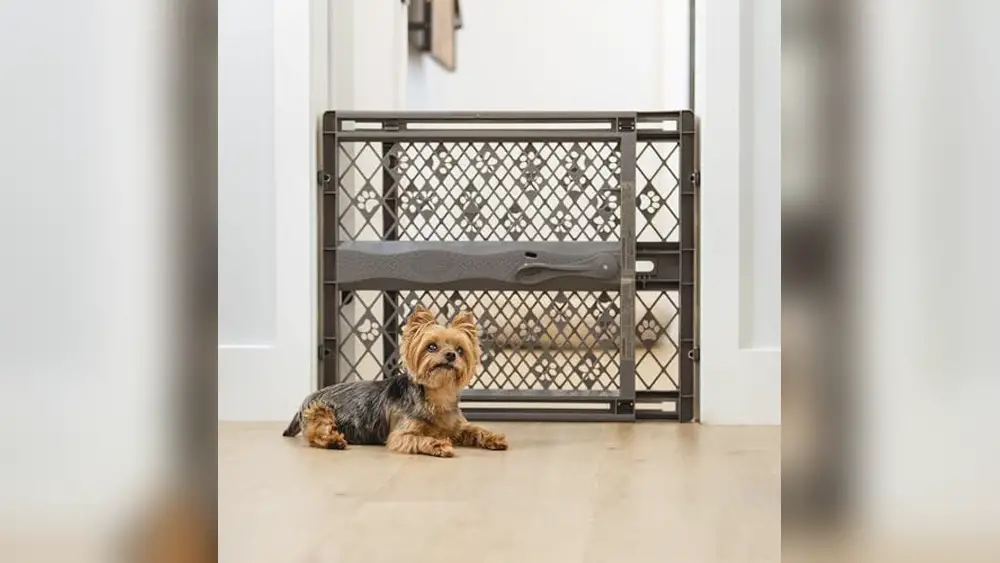
Pressure mounted pet gates are a practical way to divide indoor rooms when you have a level opening, solid contact surfaces and a pet that respects a barrier. For a temporary boundary in a 26–40 inch opening, start with the 23-inch-high MyPet Paws Portable Petgate. For an opening up to 42 inches or a setup that may later need hardware mounting, compare the 26-inch-high MyPet Universal Petgate. Measure your actual opening and check the manual before ordering either model.
As an Amazon Associate, I earn from qualifying purchases. We may also earn a commission through Walmart links. This comparison uses manufacturer specifications and installation documentation.
Shopping for a temporary doorway gate? Compare current retailer listings for the MyPet Paws Portable Petgate. Check the exact variant, delivery cost and return terms before ordering.
Compare the two pressure mounted pet gates
| Model | Manufacturer width and height | Best fit | Daily trade-off |
|---|---|---|---|
| MyPet Paws Portable | 26–40 in. wide × 23 in. tall | Occasional room separation | Solid panel across the opening. Remove it for unobstructed access. |
| MyPet Universal | 26–42 in. wide × 26 in. tall | Slightly wider openings and buyers who want an optional hardware configuration | Check the included mounting parts and read the instructions for the chosen configuration. |
Both models cover many standard interior openings, but the difference between 40 and 42 inches only matters if your contact points actually fall in that range. The extra height also matters only if your pet tends to stay behind a panel. A dog that repeatedly leans or lunges against a barrier needs a different setup from a dog that usually pauses when a doorway is blocked. Use observed behavior alongside dimensions.
MyPet Paws Portable Petgate for occasional separation

The Paws is the simpler option when you want to block a room for a particular activity, such as cleaning the floor or carrying groceries through a separate entrance. North States lists a 26–40 inch width range and a 23-inch panel height. Its adjustable panel locks into position with a handle, and rubber bumpers contact the sides of the opening. The exact installation sequence and restrictions are in the manufacturer’s Paws Portable Petgate documentation.
Consider how often you need to pass through the opening. Removing and refitting one panel occasionally can be convenient. Doing it every time you carry laundry through a busy doorway is a different matter. If the gate stays in place all day and multiple people cross it, compare a dedicated walk-through model with a latch that everyone can comfortably operate. Keep the walk path free of obstructions while the panel is removed.
The 23-inch height also makes sense only for pets that stay behind a barrier of that height. Check nearby furniture on both sides. A bench, box or chair beside the panel can give a jumping pet a much easier route across. Test your setup during a calm, supervised period and stop using it if the frame moves, the pet squeezes through, or anyone in the home has difficulty crossing safely.
MyPet Universal Petgate for a wider opening

North States lists the Universal for openings from 26 to 42 inches and offers both pressure and hardware installation configurations. The pressure setup can be useful when you need a bit more width or a taller panel than the Paws offers. The hardware setup gives you a separate installation option if your household layout later changes. Review the manufacturer’s Universal Petgate specifications and manual before deciding how you will mount it.
A clear example is a 41-inch opening measured between the actual contact surfaces. That width exceeds the Paws range and falls inside the published Universal range. A 41-inch reading between the upper jambs still leaves you with another measurement to take near the floor. If the bottom surfaces are uneven, angled or interrupted by trim, confirm that the manufacturer supports the resulting setup. A nominal width match cannot make an unsuitable contact surface usable.
For a renter, the buying decision depends on the setup permitted at that exact opening. Check which parts North States specifies for pressure mounting and which belong to the hardware-mounted configuration. Keep the hardware and instructions with the gate if you expect to switch layouts. Choosing a dual-configuration gate gives you flexibility only when your walls and opening can support the configuration you intend to use.
How to measure a doorway before you buy
- Pick the exact position. Measure between the surfaces the gate will touch. The useful dimension can change if you move the gate forward or back inside the jamb.
- Measure at the top and bottom contact points. Record both numbers. Older trim and thick baseboards can make an opening narrower lower down. Compare both against the manual’s installation requirements.
- Look closely at the contact surfaces. Raised molding, rounded posts and loose trim can leave a bumper partly supported. Move to a suitable opening or choose a mounting system designed for those surfaces.
- Check the walking route. Check where doors swing, whether you can reach their handles, and whether a folded or removed panel can be stored away from the route.
- Check your pet’s route around and over the panel. Consider the available clearance at both sides, furniture near the top edge and the way your pet behaves when you leave the room.
Write your measurements down before opening a retailer listing. Many listings group several sizes and colors on one page, and switching a variant may change the dimensions or included parts. Compare the selected variant against the model number on the manufacturer’s page before buying. If two stores carry different colors or configurations, compare the total delivered cost for the specific option you would actually install.
When to choose a different mounting style
For the top of a staircase, keep pressure-only gates out of the running. Choose a hardware-mounted model whose current instructions explicitly permit that placement and follow the manufacturer’s mounting directions. Follow the exact manual for wall cups and sockets. Some models marketed as pressure-mounted still require mounting components. The Carlson pet gate setup and troubleshooting guide explains how to identify the full model number and check its specific requirements.
For an open-plan room with no opposing walls, start by deciding where you can establish a boundary. A freestanding panel may work as a visual divider for a calm pet in a supervised room. A pet that shoves the barrier or walks around it needs a different layout or mounting system. If your gate would sit near an exterior entrance, plan an additional closed barrier before opening the outside door.
For a busy hallway, a walk-through gate may be easier to use than a removable panel. Pay close attention to the threshold bar, latch and actual clear passage. The width of the door inside a gate can be much smaller than the full frame width. If someone routinely carries a pet carrier or uses a mobility aid, measure the clearance they need before adding any barrier to that route.
Two doorway layouts that change the decision
A laundry room with a 34-inch opening. If you only need separation while sorting laundry, the Paws gives you a removable panel. Before buying, confirm that the door can still move freely and decide where you will put the panel between uses. When that same opening leads to a room people use throughout the day, compare the options in our folding pet gate with door guide and look at how each design handles repeated crossings.
A 43-inch passage into the living room. The opening exceeds both models’ published range. Start with our extra-long pet gate measurement guide to identify the span and walk-through clearance you need. A wider frame can cover the opening and still leave a narrow gate door, so check both measurements before putting a model on your shortlist.
What to check after installation
Keep the installation manual handy and confirm that all parts specified for the setup are present. After fitting the gate, check each point where it meets the doorway. If a pad lands on an edge or the frame rocks, correct the fit before relying on it. Check the lock each time you reinstall the gate and follow the manufacturer’s guidance for rechecking the mounting after use.
Pay attention to the first few supervised uses. A dog that stares at a gate may settle once the routine is familiar, but repeated jumping, chewing or pushing means the boundary needs to change. Move the activity farther away from a busy doorway if possible. If the gate slips or the pet starts to climb, discontinue that setup and choose an appropriate alternative. Use a closed room or another suitable arrangement when you need a more dependable separation.
Frequently asked questions
Do pressure mounted pet gates always install without drilling?
Check the exact model and its manual. A simple expandable pet panel may install using pressure against suitable surfaces. A different pressure-mounted unit may call for wall cups or other hardware. The instructions also explain which locations and surfaces the manufacturer supports.
Will rubber bumpers leave marks on painted trim?
Rubber bumpers can help limit scuffs, but the finish, surface condition and length of use affect whether marks appear. Follow the manufacturer’s instructions for any approved accessories and check the contact surfaces periodically. Rented properties may also have rules about attachments to trim or walls.
Which gate fits a 41-inch opening?
The MyPet Universal’s stated 26–42 inch range includes 41 inches if the opening meets the manual’s other requirements at every mounting point. The Paws Portable tops out at 40 inches. Check the selected retailer variant and measure the top and bottom contact points before ordering.
Which gate makes more sense for a doorway used all day?
Compare a dedicated walk-through gate when the opening is part of your everyday route. Check the latch, the threshold and the inside width of the actual swinging door. A removable pressure panel makes more sense when people rarely cross that opening while the gate is in place.
How should I compare Amazon and Walmart prices?
Confirm that the selected listing is for the same model and configuration, then compare the delivered price, estimated arrival and return policy. A lower listed price can come with a different color, a different seller or separate shipping charges. Use the manufacturer’s model and width as the comparison point.
Which one should you buy?
Choose the Paws Portable for occasional room separation if your opening is between 26 and 40 inches and a 23-inch panel is appropriate for your pet. Compare the Universal for widths above 40 inches up to its published 42-inch limit, or when the taller panel and hardware configuration are useful. Before you check out, verify the contact surfaces, read the matching manual and decide who needs to walk through that opening every day.