

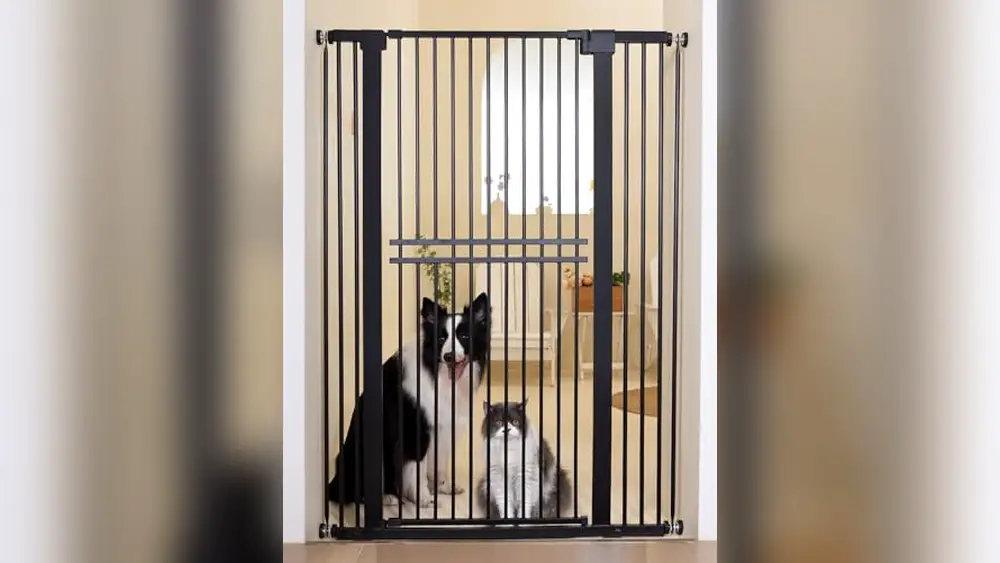
An extra extra tall pet gate is worth considering when a normal doorway barrier is too low for your household. The useful question is not simply which gate is tallest. It is whether the gate fits the opening, mounts correctly, and suits the behavior of the animal you want to keep on one side.
Affiliate disclosure: As an Amazon Associate, we earn from qualifying purchases. We may also earn a commission through Walmart affiliate links, at no extra cost to you. This is a research-based buying guide, not a hands-on product test.
What “extra extra tall” actually tells you
The phrase is a shopping description rather than a universal size standard. One seller may use it for a gate around 55 inches high, while another applies it to a different height. Always read the actual height and the supported opening range for the selected version. Do not assume the largest number in a title is the height: a listing may emphasize width instead.
This guide focuses on unusually tall doorway barriers and the tradeoffs that come with them. If you mainly need a passage for a smaller animal through the barrier, our tall pet gate with cat door guide covers that separate decision. If width is the problem, use our widest pet gate guide before buying a taller model.
Two listings to investigate, with important differences
The listings below are starting points for checking fit. They are different brands and configurations, so they do not establish a like-for-like price winner. Product details were reviewed on October 28, 2026. Retail pages can change, and your selected color or size may have different specifications.
| Listing | Advertised fit | Important buying check |
|---|---|---|
| No Pawblems, black, Amazon ASIN B0F2M4C28K | 55 inches tall; title lists 29–40 inches wide | Confirm the manual, included extension pieces, and final opening range for this exact selection. |
| Uforic, white, Walmart item 17313357785 | 55 inches tall; title lists 29.5–40 inches wide; small pet door | The description also mentions 40.5 inches. Resolve that discrepancy with the seller before ordering near the upper limit. |
No Pawblems 55-inch gate: a no-small-door option to check

The Amazon product title identifies a black No Pawblems gate at 55 inches tall for a 29–40-inch opening. That makes it a candidate to investigate if you want a tall barrier in a standard interior doorway. Confirm the exact latch design, mounting requirements, and supplied parts rather than transferring specifications from another color or a similar-looking version.
A gate without a small pass-through may be easier to assess when the goal is keeping all pets on one side. That does not mean it will contain every animal. Check the gaps around the frame and floor as well as those between the bars. Ask for the installation manual if it is not readily available before purchase.
Uforic 55-inch gate: a Walmart alternative with a pet door
The Walmart listing describes a white pressure-mounted Uforic gate with auto-close and a small pet door. Its title gives a 29.5–40-inch opening range. A conflicting 40.5-inch figure appears in the description, so do not order it for a borderline opening until the seller confirms the fit.
The small door is a functional difference from the Amazon option above. It may be useful when one animal should pass, but a small dog may also fit through an opening intended for a cat. Check whether the door can be locked in the position you need, and assess each animal under supervision. Do not treat the retailer’s impact or escape-prevention wording as a guarantee for your pet.
Amazon vs Walmart: price comparison status
| Comparison | Amazon | Walmart |
|---|---|---|
| No Pawblems B0F2M4C28K, same selected variant | Listing identified; current checkout price not verified. | Matching product and variant not confirmed. |
| Uforic item 17313357785, same selected variant | Matching product and variant not confirmed. | Listing identified; current checkout price not verified. |
| Cheaper retailer | No verified like-for-like winner. Compare the same model, color, extensions, seller, shipping, and returns before deciding. | |
We have not substituted the price of a recommended or sponsored item for the price of the gate itself. A retailer page can display several nearby offers, and those prices may belong to completely different products. Open the exact listing, select the size, enter your delivery location, and compare the final total. Include required accessories in that total.
Marketplace seller terms matter too. Check who ships the gate, who handles a return, and whether return postage or restocking charges apply. Keep a copy of the selected variant and the seller’s fit confirmation. A lower advertised price offers little value if the gate cannot be installed in your opening or is costly to return.
Measure the doorway before choosing the height
Take measurements at the points where the mounting pads or brackets will sit. A doorway can be narrower near a baseboard than higher up. Record the width near the floor, at the lower fixing position, and at the upper fixing position. Compare every relevant measurement with the manufacturer’s supported setup, including any restrictions on extension combinations.
Next, measure the clear height above the floor and look for obstacles around the proposed gate. A shelf, chair, counter, or nearby cat tree may become a launch point. A tall barrier placed beside furniture can be easier to bypass than a shorter barrier in an uncluttered opening. Move climbable items where practical, then reassess whether a gate is appropriate.
Also check the space needed for the door to swing. A gate may fit between the walls while its door hits a cabinet or another door. Think about carrying laundry, using a mobility aid, and moving through the opening with a pet nearby. Measure the actual walk-through space if that dimension matters to your household.
For example, if an opening measures 39 inches at the upper mounting position but has projecting trim lower down, the headline 29–40-inch range is only a starting point. Compare the trim depth and both contact positions with the installation diagram. Ask the seller to identify the supported extension arrangement. A measurement inside a broad advertised range does not establish compatibility when the contact surfaces or extension rules differ. Resolve these details while the gate is still returnable, rather than forcing the frame into place.
Choose mounting by the location and the manual
Pressure mounting uses tension between opposing surfaces. It requires suitable contact points and careful adjustment. Some products still require fixed wall cups or other hardware even when their marketing says “no drill.” Read the installation instructions for the exact model. Do not remove a required part to protect paintwork or make the installation look neater.
Pressure pads can leave marks or damage finishes. Loose trim, weak surfaces, or an uneven opening can create additional problems. If you rent, check the mounting instructions and the relevant property rules before ordering. Ask the manufacturer about an approved solution for your wall or baseboard rather than improvising blocks or using unrelated extensions.
For a stair location, buy only a product explicitly suitable for that position and install it exactly as directed. Do not place an ordinary pressure-mounted pet gate at the top of stairs. A pet-only product should not be assumed to meet child-safety requirements. Households with children need to check the intended use and warnings separately.
Our wall mount pet gate guide discusses fixed installation considerations. Changing from pressure mounting to hardware mounting is a product choice, not a modification to improvise on a gate that was not designed for it.
Match the barrier to your pet’s behavior
For a calm dog that already respects household boundaries, a gate may serve as a useful room divider. For a dog that jumps, climbs, bites bars, or pushes hard against barriers, adding height may leave the underlying problem unchanged. Observe the animal in a controlled setting and stop using the setup if it encourages repeated attempts to escape.
Cats can use both jumping ability and nearby surfaces. Narrow bar spacing does not by itself prove that a gate is safe for kittens or that a cat cannot climb it. Examine the bottom gap, hinge area, and small door as well. Never force a pet’s head through a gap to test the fit.
If separation is needed because animals are fighting, a gate can still allow visual contact and contact through the bars. It may be unsuitable as the only boundary. Choose a separation arrangement that prevents the contact you are trying to avoid, and get appropriate professional help for persistent behavior concerns.
Check daily usability and maintenance
A latch should be easy for the adults who use it to operate as instructed, and it must engage reliably. An auto-close feature is convenient only when the door actually latches under the conditions specified by the manufacturer. Test it after installation, check it as part of your routine, and never assume a door is secure simply because it has swung shut.
Look down as well as up. A bottom rail can create a trip hazard, particularly in a busy route or dim hallway. Do not add a homemade ramp or change the threshold unless the manufacturer permits that accessory. If the arrangement makes ordinary access awkward, a different gate or a different location may be a better choice.
Inspect the mounting points, frame, hinge, latch, and extensions regularly and whenever the gate has been struck or moved. Follow the cleaning instructions and stop using damaged components. Keep the manual and model information so replacement parts can be matched correctly. Parts that look similar are not necessarily interchangeable.
Before you order: a practical checklist
- Record the actual opening measurements and any baseboard offsets.
- Verify height, width range, included extensions, and the selected color or version.
- Read the installation manual and all location restrictions.
- Check bar gaps, floor gaps, and any small pet door for every animal in the home.
- Confirm walk-through clearance, swing space, and threshold accessibility.
- Compare the same model and accessory package when comparing prices.
- Check seller identity, delivered total, and return conditions.
- Plan supervised introduction and routine latch and mounting checks.
Frequently asked questions
Will a 55-inch gate stop a cat?
It may help manage access for some cats, but it is not a guarantee. Climbing behavior, nearby furniture, gaps, and the individual animal all matter. If escape would create a serious hazard, use a more appropriate separation arrangement.
Is a taller gate always better for a large dog?
No. Height does not establish resistance to pushing, the strength of the mounting surface, or suitability for a determined dog. Choose by the complete installation requirements and your dog’s behavior.
Can I buy extra extensions from another brand?
Only use parts that the manufacturer approves for the exact model and opening. Mixing extensions can change the stability and invalidate the supported installation.
Can a pressure-mounted gate avoid all wall damage?
No product description can promise that for every wall finish. Contact pressure, movement, and required fixing hardware can affect surfaces. Check the manual and installation location before purchase.
Which retailer is cheaper for the same extra extra tall pet gate?
We could not verify a current like-for-like price comparison for these selections. The Amazon and Walmart examples above are different products. Check an exact match and the final delivered total before choosing.
Sources and buying decision
Listing references: Amazon No Pawblems B0F2M4C28K and Walmart Uforic item 17313357785. The dimensions quoted here are retailer-listed details, not independent measurements.
Choose an extra extra tall pet gate only after fit, mounting, animal behavior, and everyday access all make sense together. If the opening or the pet does not suit the product, choose a different separation solution instead of trying to make a taller gate compensate.