

Affiliate disclosure. This article contains paid Amazon and Walmart links. As an Amazon Associate I earn from qualifying purchases. We may also earn a commission from qualifying Walmart purchases.
Quick answer. In a wood vs metal pet gate comparison, start with mounting and your dog’s behavior. A wooden freestanding gate can suit a calm dog that respects a movable room boundary. A mounted metal walk-through gate can suit a doorway used many times a day. Check height, gaps, fastening and the clear passage before choosing either material.
Buttons open retailer searches. Match the exact model, dimensions and included hardware before comparing the full checkout cost.Wood can coordinate with furniture, while metal can offer a slim frame and a walk-through door. Those descriptions leave out important differences between individual products. Some wooden gates contain metal wire. Some metal gates stand freely on the floor. A product’s material tells you about its construction, while its mounting system determines how it is supported.
This guide uses manufacturer specifications and manuals to compare two examples, a Richell wooden freestanding gate and a MidWest steel walk-through gate. The examples show how to make the decision for your own home. The recommendations are based on documented features and fit checks.
Wood vs metal pet gate comparison
| Decision | Wooden gate considerations | Metal gate considerations |
|---|---|---|
| Construction | Check solid wood, engineered board, frame joints and wire infill | Check the frame, coating, hinges and any plastic latch components |
| Support | Freestanding, pressure and hardware-mounted designs exist | Freestanding, pressure and hardware-mounted designs exist |
| Daily crossing | Some models need stepping over or moving aside; others have a door | Many doorway models have a walk-through door and bottom threshold |
| Dog behavior | Inspect accessible wood if your dog chews or paws at barriers | Check all components and choose mounting appropriate for the dog |
| Outdoor placement | Choose an explicitly outdoor-rated model and its approved setup | Choose an explicitly outdoor-rated model and its approved hardware |
Use this table to ask better questions about the exact product. It cannot predict whether a particular dog will remain behind a particular barrier. A dog that jumps, climbs or pushes at an existing gate may need a different arrangement and help with the behavior driving those attempts.
Decide the mounting system before the finish
First identify the place you want to divide. Is it a level room entrance, a wide living area, a doorway near a staircase or a patio opening? Write that location down before searching by color. The same width can require different mounting arrangements depending on the surfaces on each side and the consequences of a pet getting past.
A freestanding gate uses its feet, side panels or shaped layout for support. It can be convenient for a supervised indoor boundary and easy to move when the room changes. Its usable width may depend on keeping panels at the specified angles. Include the footprint in your measurements so people can walk around projecting feet without catching them.
A pressure-mounted gate depends on suitable contact surfaces and the manufacturer’s installation requirements. Check whether cups or screws are required for your chosen location. A hardware-mounted design fixes brackets to appropriate surfaces. Confirm the fasteners and underlying structure before installing either type. Material alone does not tell you which mounting system a listing uses.
If moving the gate frequently is your priority, compare our wooden freestanding gate guide. For a fixed indoor doorway, our pressure-mounted pet gate comparison covers additional formats.
Wooden example: Richell Freestanding Pet Gate Small

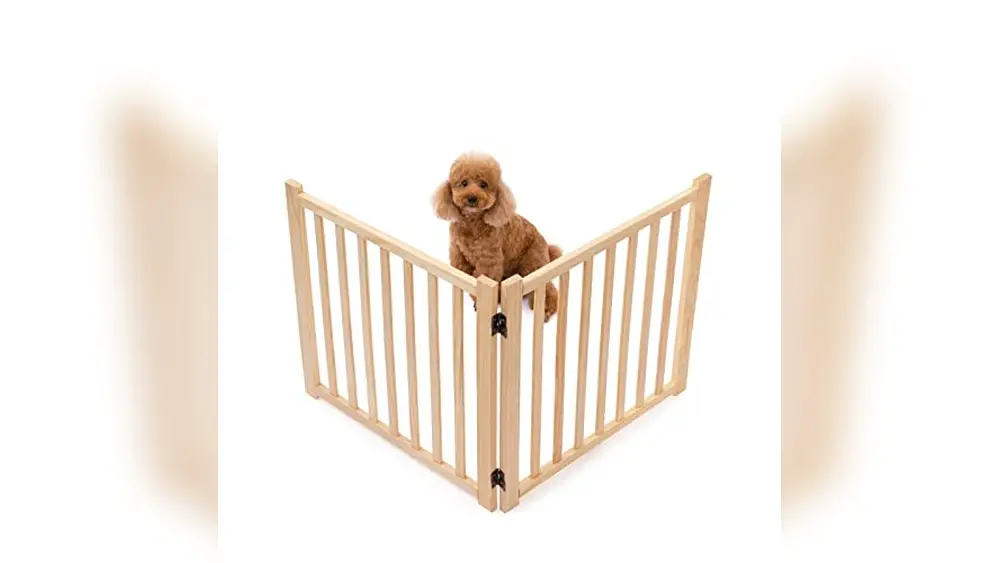
The Richell Small product page lists a 26.4–40.2-inch opening range, 17.7-inch depth and 20.1-inch height. It uses rubberwood and wire, with a listed 1¼-inch gap between wire slats. This is a useful example of why a “wooden” gate can include substantial metal components.
Its low height and movable format are worth considering for a calm small dog and a level room boundary. Check your ability to cross the gate comfortably. If you regularly carry a laundry basket or use a walking aid, compare a model with a suitable door. Set out the depth on the floor before ordering so the side supports fit the space available.
The manufacturer’s Small/Large installation manual limits placement and use. It identifies the product for indoor use, warns against placing it at the top of stairs and requires the pet to remain in sight. Consult the current model’s manual and pet-size recommendation before purchase.
This example makes sense when portability, appearance and a low indoor divider fit your routine. For another wooden layout, compare the options in our folding gate with door guide. Check each model’s setup requirements individually.
Metal example: MidWest Steel Pet Gate

The MidWest Steel Pet Gate product page lists 29-inch and 39-inch height options, a 29.5–38-inch opening range and a 19-inch walk-through door. Confirm the extension configuration in the installation document for your measured opening. A family’s available height options can appear together on a retailer page.
A walk-through format is worth comparing for a busy kitchen or hallway. Mark a 19-inch passage on the floor and try walking through with your usual equipment. Check the swing space and the bottom threshold. A full-width gate can leave a much smaller passage, and your own daily route should determine whether that passage works.
Review the mounting cups and support surfaces before choosing a pressure-mounted setup. Keep the exact model and height with your extension shopping list. Accessories for another gate family or height need specific compatibility confirmation from the maker.
For a fuller model comparison, see our MidWest vs Regalo steel gate guide. It includes an example of separate width intervals that can be hidden behind a retailer’s headline maximum width.
What to consider if your dog chews
Look at where your dog actually puts its mouth. With a wooden gate, inspect the accessible frame edges, corners and joints. With a metal gate, inspect the latch housing, feet and adjustment pads as well as the bars. The frame material gives only part of the picture because many products combine several materials.
Watch the first supervised uses and inspect the gate for damage. If the dog repeatedly bites the barrier, keeps trying to squeeze through it or becomes distressed, address that behavior before relying on the setup. Consult a qualified trainer for persistent problems. A material upgrade does not resolve the reason a dog is trying to get to the other side.
Buy replacement parts through the manufacturer or an approved source. If a component is damaged, keep the dog away from the opening until it is resolved. Avoid changing the spacing or attaching a homemade infill without the manufacturer’s approval, since that changes how the product behaves.
Measure the opening and the route through it
Record the width at the proposed lower and upper contact points. Baseboards may make the lower opening narrower. Rounded trim or uneven plaster can also change where a mounting pad can sit. Photograph the proposed location straight on and from the side so you can discuss it accurately with support if needed.
For a freestanding model, record depth as well as width. Place removable marks on the floor where the feet or return panels would stand. Open the room’s existing door and check whether its handle or swing will hit the gate. Include a route for people approaching from either direction.
For a walk-through model, measure the clear passage separately from total gate width. Consider a vacuum cleaner, basket or mobility equipment that must pass through. Then check the door’s swing and the handle’s location. A convenient latch in a product photo may be awkward when it sits beside a kitchen cabinet.
Finally, consider the gaps at the floor, along the sides and within the gate. Check the smallest pet needing containment. Consider jumping behavior for the most athletic pet. Our pet gate height guide explains the related height decision.
Three household examples
A calm small dog beside a home office
A wooden freestanding format can be useful when the pet remains in sight and the boundary is on a level floor. Confirm the manufacturer’s size recommendation and keep the projecting feet clear of your chair and walking route. If crossing the low gate is uncomfortable, compare a door model before choosing the finish.
A kitchen doorway crossed throughout the day
Prioritize passage width, latch access and the swing path. Compare a mounted walk-through format in wood, metal or a combination of the two. Take measurements while the kitchen door and nearby cabinets are open. Check whether carrying dishes through the available passage feels practical.
A dog that pushes hard whenever visitors arrive
Start by reviewing the dog’s behavior and a suitable containment plan. Ask the gate maker whether a proposed model and installation suit that use. Consider the mounting surfaces and nearby furniture. A heavier-looking gate or taller panel does not establish that the complete setup can handle your dog’s behavior.
Appearance, cleaning and long-term use
Choose the finish after the fit and daily route work. Compare a wooden frame with your flooring and furniture in ordinary room light. For a painted or coated metal gate, check the actual color selected in the listing. Product families often mix several colors and heights under one page.
Follow the maker’s cleaning directions for each surface and component. Inspect joints, hinges, feet and latch parts as part of routine use. Keep the instruction document and model number accessible. They help when ordering a replacement part or asking whether an accessory fits.
For outdoor placement, check explicit approval for the environment and hardware. Our outdoor deck and patio gate guide covers a model intended for that setting and its extension requirements.
Amazon vs Walmart: compare matching packages
Use the retailer searches for the exact model you want, then select the correct height and color. Confirm whether the item is a complete gate, a replacement panel or an extension. A low accessory price can appear beside full gates in the same search results.
List every required part before comparing totals. Include extensions, approved mounting hardware and delivery to the same ZIP code. Check the seller, arrival date and return terms. For mixed orders, establish whether the gate and accessories can be returned separately.
Prices and availability change. Compare the full delivered amount on the retailer pages and save the selected package details with the receipt. Check the box contents against the manual before assembling or drilling. That makes a missing part easier to identify while the purchase details are still close at hand.
Frequently asked questions
Is a metal pet gate always more secure than wood?
Security depends on the complete gate, mounting, fit and the dog’s behavior. Compare the exact installation requirements, height and gaps for the products you are considering.
Can a wooden pet gate have metal bars?
Yes. Richell’s Small freestanding example uses a rubberwood frame with wire infill. Review the parts list when the material at a particular edge or contact point matters.
Which gate is easier to move?
A freestanding format is designed for placement without attaching it to the doorway. Check its weight, folded size and assembly instructions. Mounted gates have their own removal and reinstallation requirements.
Which material works outdoors?
Choose a model whose manufacturer explicitly permits outdoor use. Review its exposure limits, approved fasteners and mounting instructions before buying for a patio or deck.