

Affiliate disclosure: As an Amazon Associate I earn from qualifying purchases.
Compare 36-, 48-, and 55-inch extra tall pet gates by looking at how your pet crosses barriers. A dog that jumps from the floor, a cat that climbs bars, and a puppy that squeezes around the hinge need different features. Measure the doorway, look for launch points on both sides, and then decide how much height will help.
Compare 36-, 48-, and 55-inch pet gates
| Gate height | When to start here | Check before buying |
|---|---|---|
| 36 inches | A dog that already respects barriers | Walk-through width and latch |
| 48 inches | A pet that clears a shorter panel from floor level | Bar spacing, footholds, and mount fit |
| 55 inches | A higher floor-level jump in a suitable doorway | Mounting points and nearby furniture |
When a 36-inch gate makes sense
A 36-inch walk-through gate is a reasonable starting point when your dog already respects a shorter barrier and you want a taller boundary that adults can open easily. Think about the reason for the upgrade. If you are replacing a short step-over gate because people trip over it, a walk-through door may solve more of the problem than another foot of panel height. If your dog clears the old barrier, work out how they did it before selecting the new one.
The Carlson 0941 is one example of a 36-inch gate with a separate small pet door. Check the model number and installation instructions for the exact version you are considering. A small door is useful only when it works for the animals on both sides. A dog small enough to follow the cat through the opening can defeat the setup, and some pets may learn to nose a flap that someone forgot to latch.
The Carlson 0941 fit guide explains why the stated width range depends on the extension configuration. Measure at the bottom and top of the frame before ordering. A 36-inch gate that fits and closes consistently is a better match for an ordinary doorway than a taller gate that needs the adjusters stretched beyond their permitted range.
When to compare 48-inch gates
A 48-inch gate adds a full foot above a 36-inch model. That can make sense after you have seen your pet jump cleanly over a shorter panel from the floor. Start by watching where the animal takes off. A dog jumping from a running start down a clear hallway presents a different problem from a cat launching off a console table. Moving the table or changing the doorway can improve the setup before you buy anything.
For cats, compare vertical bar spacing, gaps at the hinges, and the distance between the lowest rail and the floor. Look at both sides of the gate for useful footholds. A latch housing, horizontal rail, or nearby shelf can give a climber another point of purchase. Look at the installed product photos alongside the manual, since a studio photo of the frame often leaves out the spaces that appear after installation.
At this height, decide whether every adult in the home can comfortably use the door and reach the latch. If the hallway is unusually wide, use our extra tall and wide pet gate guide to work through width and extensions. A tall gate with a narrow walkthrough can also be awkward when you carry laundry, a pet carrier, or a vacuum.
When a 55-inch gate is worth considering
A 55-inch gate gives you seven more inches than a 48-inch model. Those inches are useful when the pet is clearing shorter gates from floor level and the doorway gives you sound mounting surfaces for the taller frame. If the same pet climbs vertical bars or reaches the top from nearby furniture, consider a closed door or a different room layout. Height alone cannot predict whether an individual pet will stay behind a gate.
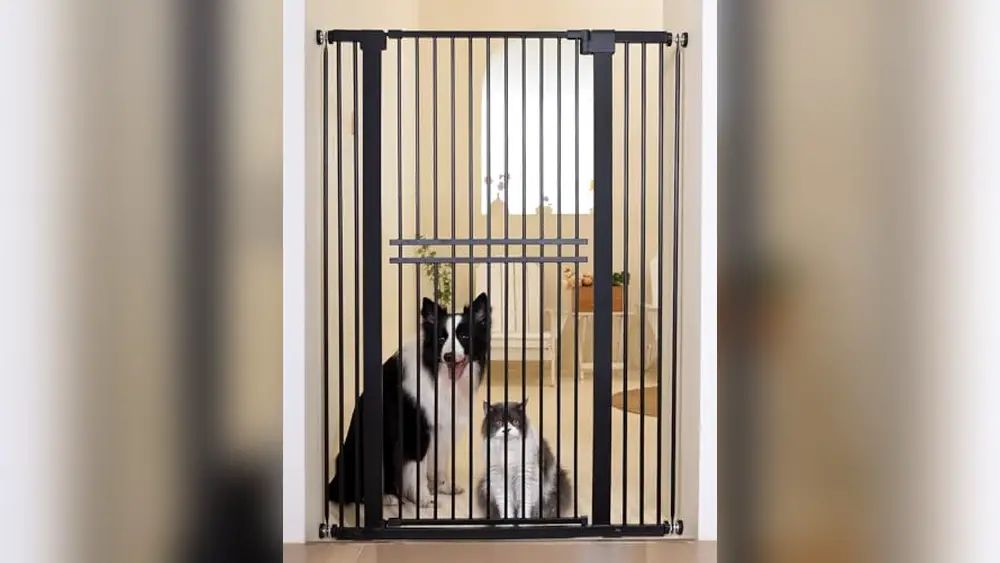
The black No Pawblems model associated with Amazon ASIN B0F2M4C28K is listed as 55 inches high and 29–40 inches wide. The range belongs to that selection. Other variations may have a different width or different included parts. Ask the seller to confirm the extension configuration if your doorway measures near an endpoint. Confirm the exact model before ordering, especially when an online listing groups multiple heights and widths on one page.
Our 55-inch pet gate buying guide covers the specific listings in more detail. If your household also needs a small pass-through, use the extra tall pet gate with cat door guide to check which measurements matter before selecting a model.
Measure the opening and the places your pet can jump from
Start by sketching the doorway. Write down the clear width at the floor and again at each height where the gate will touch the trim or wall. Record the smallest and largest readings. If the opening narrows at the baseboard, a measurement taken at waist height can make the gap look wider than it is. An older doorway can also be slightly out of square, so measure both mounting faces and check them against the manual.
Measure the free space in front of and behind the gate, too. Mark the approximate arc of the walk-through door with painter’s tape so you can see whether it would hit a shoe rack, the main room door, or a closet handle. Check the direction the gate is permitted to swing and whether you can reach the latch from both sides while holding a leash. In a heavily used hallway, this small check can save daily frustration.
Then walk the route your pet takes. A 55-inch panel measured from the floor offers much less effective height next to a 20-inch bench. The difference is about 35 inches from bench to gate top before you account for the horizontal jump. Move the bench well away, including on the side the pet is trying to reach. A chair, cat tree, storage box, or windowsill can create the same issue.
Look closely at the lower corners after installation. Uneven flooring, thick rugs, and baseboards can change the clearance there. A toy-breed dog or kitten may investigate those gaps long before it tries to clear the top. Measure the actual installed opening and compare it with the manual. If the gate shifts when it closes or the corners leave a gap you cannot resolve with approved parts, choose a different location or a compatible gate.
Check mounting and daily use before depending on the gate
Pressure-mounted designs can work in indoor doorways where the manual permits them and both contact surfaces are suitable. Use any wall cups or fasteners specified for your configuration. For a stair landing, use a gate whose manufacturer explicitly approves the exact location and mounting method. Follow that manual, including its rules about hardware, swing direction, and orientation. If a gate is going to be used as a child safety barrier, select a product intended for that use and consult its child-safety instructions.
Once the gate is installed, open and close the door from both sides. Test from a small opening as well as a full swing. Verify that the latch fully engages each time, and show everyone in the household how to check it. Some mechanisms behave differently when the gate is almost closed. If you have to lift, twist, or slam the door to latch it, revisit the alignment using the manufacturer’s instructions.
Pay attention to what changes in the first few days. A door that starts rubbing or a frame that moves can indicate a fit problem. Follow the inspection and tightening instructions for the model. The latch alignment guide explains which symptoms to look for on mounted walk-through gates. Replace damaged parts with components the manufacturer approves for that model.
Observe your pet during early use. If they jump repeatedly, push at the frame, bite the latch, or try to squeeze through the bars, end the trial and change the setup. A gate used to keep a calm dog out of the kitchen serves a different purpose from a barrier separating two animals that lunge at each other. For the latter situation, a closed room and a plan for moving pets through the home may be more appropriate than any walk-through gate.
Work through two doorway examples
Say you have a 34-inch kitchen doorway and a dog that waits at a short barrier but follows people when the barrier is lifted. Start with a walk-through gate that lists your width in its supported configurations. Check that an adult can carry a food bowl through and close the latch without setting it down. In this case, door clearance and reliable closing are likely to matter more every day than a taller frame.
Now picture a cat clearing a short hallway gate from the top of a shoe cabinet. Move the cabinet and watch how the cat approaches the opening while you are there. If the cat still jumps directly from the floor, compare the 48- and 55-inch options against your width and available mounting surfaces. If the cat tries climbing instead, rethink the doorway or use a solid door. Buying a taller version of the same climbable design may leave you with the same escape route.
Common height and fit questions
Is a 36-inch gate tall enough for a large dog? Look at what the dog does around barriers today. Some large dogs respect a low boundary. Others jump or push when excited. Consider the pet’s behavior, the approach to the doorway, the mounting location, and the actual latch before choosing a model.
Will a 55-inch gate stop a cat? It may discourage a cat that jumps from the floor and ignores the bars. A cat that climbs or launches from furniture can still get around it. If you need to keep the cat in a room while nobody is there, consider whether a closed door is more dependable for that household.
Should I add extensions to make a tall gate fit a wide hall? Use the extension parts and combinations listed for the exact model and opening. Check the manual before assuming that the maximum advertised width comes with everything in the box. If your opening is between supported configurations, choose a frame or kit that covers your measured width.
Can the gate stay installed when the pet grows? Recheck both ends of the problem. A puppy that once fit through the lower gap may later be large enough to jump or push against the frame. Review the setup when your pet’s size, strength, or behavior changes. Take the same approach if you move the gate to a different doorway.
What should I write down before shopping? Record the narrowest and widest opening, mounting surface material, needed door swing, where the pet takes off, and whether there is furniture near either side. Add the exact model number, included extension pieces, and any mounting hardware required by the manual. Those details let you compare two listings without relying on the words extra tall.
Installation references: Carlson product manuals and the CPSC gate and enclosure standard.