

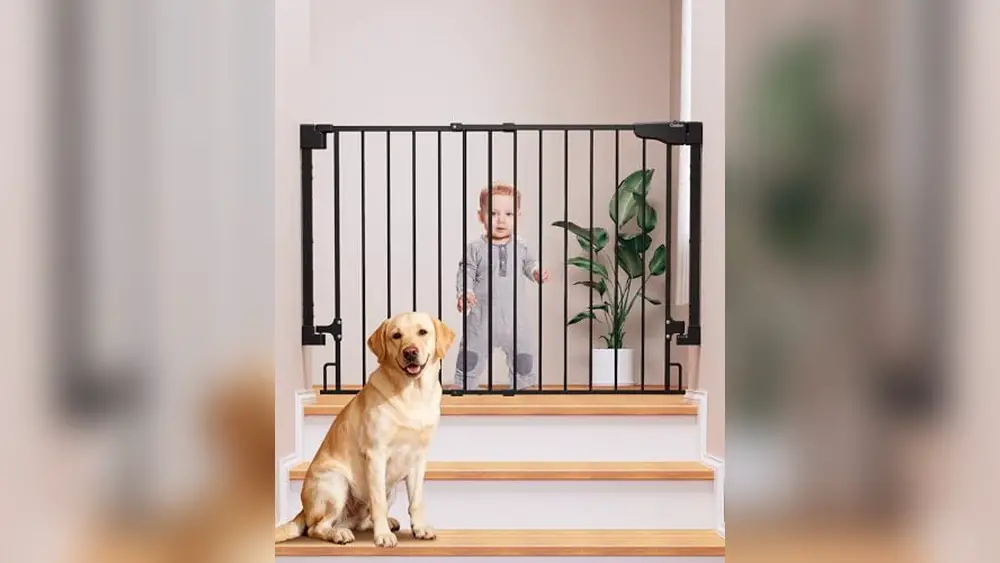
A wall mounted pet gate that won’t latch needs an installation check before you rely on it again. The problem may be a shifted mounting bracket, a sagging panel, a blocked latch or an incorrect width adjustment. Start by identifying which part fails to meet; buying a taller or more expensive gate will not fix a misaligned installation.
Affiliate disclosure: As an Amazon Associate, we earn from qualifying purchases. We may also earn a commission through Walmart links, at no extra cost to you.
Identify the latch problem before adjusting anything
Take a close photograph with the gate almost closed, then another showing both mounting sides. Note the model number and whether the latch worked previously. A new gate that never latched and an older gate that suddenly stopped closing can need different fixes.
| What you see | What to inspect | Next step |
|---|---|---|
| Latch passes above or below its receiver | Panel level, hinge position and receiver alignment | Compare the installed positions with the model’s template |
| Panel reaches the receiver but does not lock | Debris, damaged parts and the required closing motion | Check the operating instructions and inspect the mechanism |
| Gate drags on the floor | Sagging, loose hinges or installation clearance | Find the cause before changing bracket height |
| Mounting bracket moves against the wall | Fastener and supporting surface condition | Stop using the barrier and resolve the mounting fault |
| Gate closes from one position but stays open from another | Whether the model has a stay-open setting | Check the specified closing range in its manual |
These are diagnostic starting points, not proof of a particular fault. Do not force a latch shut to compensate for an installation problem.
1. Confirm the exact gate and its instructions
Find the label, order record or original packaging. Similar-looking gates can have different hinges, release actions and mounting requirements. Match the model and revision before ordering parts or following a video.
Record four details: opening width, gate model, mounting surface and the symptoms. Send those details and your photographs to the manufacturer if the manual does not explain the problem. That is more useful than asking whether “a universal latch” will fit.
2. Check whether the mounting points have moved
Look for a bracket separating from the surface, an enlarged hole, a cracked frame or loose hardware. Do not simply keep tightening a screw that no longer grips. The supporting surface and permitted fixing method must match the manufacturer’s instructions.
For example, the North States instructions for models 4950/4955/4972 specify solid mounting materials and exclude sheetrock or plaster for the supplied mounting hardware. They also require periodic fastener checks and stopping use if parts are missing or damaged. Those directions apply to those models; do not assume another brand uses the same hardware.
If you cannot establish what is behind the wall or whether a damaged mounting point can be reused, get help from the manufacturer or a qualified installer before reinstalling.
3. Compare hinge and latch alignment
With the opening secured separately, compare the gate’s resting position with the receiver. Does the panel droop? Is one bracket tilted? Does the latch line up only when you lift or push the panel sideways?
Use a level and the original template as inspection tools. Change only adjustments described in the manual. A gate that needs an unusual shove or lift beyond its normal opening and closing action still needs attention.
Check all required locking points. If a model has upper and lower catches, one catch engaging does not demonstrate that the other is installed correctly.
4. Recheck width, clearance and obstructions
Compare the opening measurement with the approved range for your exact size. Look for skirting boards, trim or a nearby door that prevents the gate from reaching the receiver. Check whether the panel is rubbing against flooring or a rug.
Do not raise the entire barrier arbitrarily to clear an obstruction: the manual may set a maximum floor gap. Do not add homemade spacers, combine unrelated extensions or modify the latch to make an unsuitable gate fit.
If the original installation used an extension, confirm its model compatibility and assembly sequence. The wall mount pet gate buying guide covers choosing an appropriate mounting style before installation.
5. Separate auto-close behavior from latch engagement
A swinging panel and a locked gate are different things. Watch the complete closing movement, then verify the lock using the method in the manual. Do not rely on the sound of a click alone.
Some gates have a deliberate stay-open position. For example, Babelio lists auto-close and stay-open features for its Boundless B17 range. Check the instructions for the version you own before treating a panel that remains open as a broken spring. Keep pets away during inspection and avoid testing by allowing an animal to push against the gate.
Repair or replace: which makes more sense?
- Adjustment may be appropriate: all parts are intact, the mounting surfaces are sound and the manual describes the required correction.
- Ask for an original replacement part: the manufacturer confirms the fault and identifies a compatible latch, hinge or mounting kit.
- Consider another gate: the opening is outside the approved range, the necessary support is unavailable or the manufacturer cannot supply a required part.
For any broken, bent or cracked component, stop relying on the gate while you seek a repair decision. A cosmetic patch is not evidence that a locking part has recovered its strength.
Two replacement options to compare after measuring
These are specification-based alternatives, not hands-on test results. Retailer buttons open searches so you can compare the exact model, size and seller. We have not verified live checkout prices or availability, and neither store is claimed to be cheaper.
Cardinal Gates Stairway Special SS-30
The manufacturer lists a 27–42.5-inch opening range, 29.5-inch gate height and mounting at angles up to 30 degrees. This makes it an option to investigate when mounting alignment constrains your choice. Confirm the selected version and compatible accessories before purchasing.
Tradeoff: it still needs a suitable installation surface and correct latch positioning. It is not a repair for damaged wall support.
Find SS-30 on AmazonCompare SS-30 on WalmartBabelio Boundless B17
Babelio offers this hardware-mounted range with no bottom bar and multiple width and height variants. The product page includes 28- and 34-inch height choices; available combinations must be checked in the selected listing.
Tradeoff: the manufacturer calls for flat, parallel mounting sides. Check your wall profile and exact version rather than selecting by the B17 name alone.
Find B17 on AmazonCompare B17 on WalmartBefore returning the gate to everyday use
Work through the manufacturer’s final installation checks, including mounting security, permitted gaps, opening direction and full latch engagement. Test the specified operation without your pet in the opening. If a check fails, keep using the separate secure area and contact support.
For a stair location, use only a model and installation specifically permitted there by its manufacturer. A working latch does not, by itself, establish that the gate is suitable for that location.
Frequently asked questions
Why did my wall mounted pet gate suddenly stop latching?
Inspect for moved mounting points, a sagging panel, obstructions or damage. A change in behavior deserves a fresh installation check even when the gate previously worked. Photographs of the latch and both mounting sides can help the manufacturer identify the cause.
Can I replace the latch with a universal one?
Get the manufacturer’s confirmation of compatibility first. Matching appearance or screw spacing alone does not show that the replacement will lock and release as designed.
Should I buy a pressure-mounted gate instead?
Choose by location, mounting permissions and your pet’s behavior. Read our tension pet gate setup guide for that mounting style. Changing mounting style does not remove the need to verify suitability and locking.
Will a taller gate solve this problem?
Height and latch alignment are separate decisions. A taller gate can still fail if it is incorrectly installed. If your pet climbs or jumps, reassess the overall containment setup instead of treating latch adjustment as the complete solution.
Next step: identify the model, photograph the misalignment and check the original instructions before buying parts. If replacement is necessary, measure first and compare the full installation requirements.