

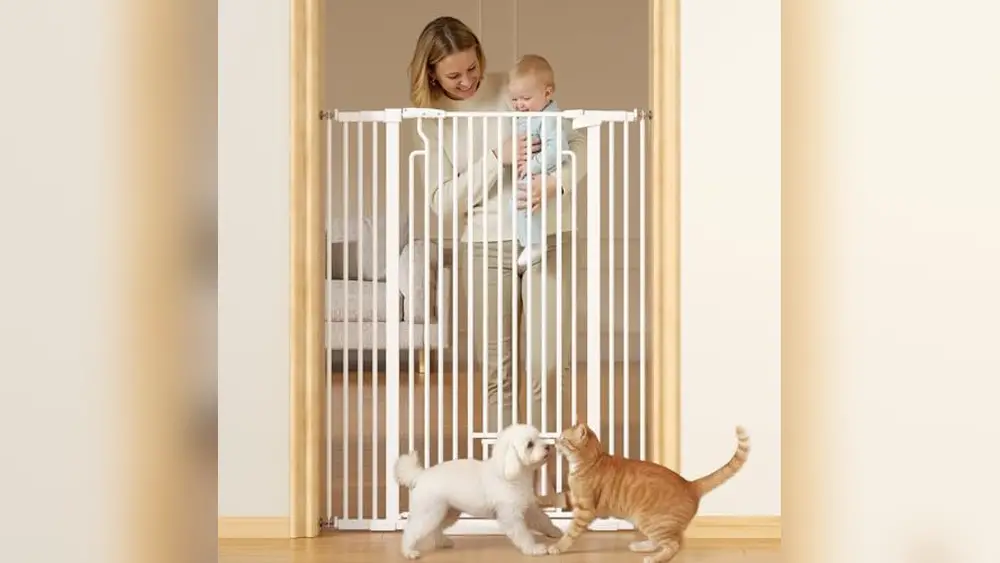
Choose an extra tall pet gate for cats by checking the whole doorway for escape routes. Height matters, and so do the openings above the frame, beside the jambs and along the floor. A tall gate with a wide space beside the frame can still leave a usable route. Start with the location you want to block, then compare the actual dimensions and mounting requirements of the exact model.
For a level interior doorway, the Richell Steel Cat Safety Gate is one tall, tension-mounted option. The white 94953 has an assembled height of 71.5 inches and a published width of 28.5 to 37.5 inches. Richell recommends this model for cats up to 11 pounds. Confirm the doorway, cat and floor layout before ordering. This guide uses the manufacturer’s specifications and manual to evaluate fit.
As an Amazon Associate I earn from qualifying purchases. PetPotLuck may also earn a commission from Walmart links.
What to Check Before Buying an Extra Tall Pet Gate for Cats
| Check | Where to measure | Why it matters |
|---|---|---|
| Opening width | Between the mounting faces at the top, middle and bottom | Trim and baseboards can change the usable width. |
| Clear height | Finished floor to the first obstruction over the planned gate | The frame must fit and any space above it remains accessible. |
| Bar and perimeter gaps | Between bars and beside, above and below the assembled frame | The largest usable opening may be at the edge. |
| Door swing | Across the full swing on the side the door opens toward | A latch can be hard to use if the door hits a fixture. |
| Approach and landing | On both sides of the doorway | Furniture can serve as a launch point or foothold. |
Start with a sketch of the doorway and label the side the cat will occupy. Draw the baseboards, door stops and nearby furniture. Mark which surfaces the mounting hardware will actually touch. A dimension taken from one decorative edge to another can be different from the space the gate has to span. Write down the actual measurements and bring the sketch to the product manual as you read it.
Measure the door opening above floor mats and along the floor with the mats removed, then decide what can remain in place under the manufacturer’s instructions. A carpet edge, a transition strip or a threshold can affect the way a walk-through door moves. If the floor drops away on one side, or the bar would sit where the cat could go underneath, use a different doorway or a barrier designed for the location.
Height, Side Gaps and Climbing Routes
Plan for the cat you have seen in that room. Some cats jump onto the nearest piece of furniture before investigating a barrier. Some climb where they find a foothold. Others watch the doorway and go through when a person opens it. A cat that can reach the top of a cabinet may approach a tall gate differently from a cat that only noses along the edges of a door.
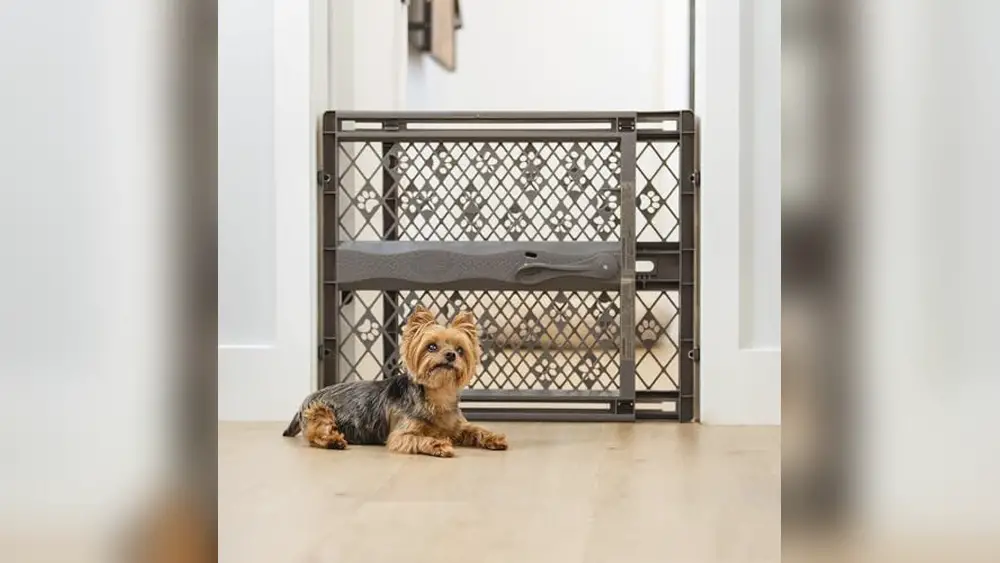
Look at the pattern of the gate at a cat’s eye level. Horizontal rails, decorative cutouts and projecting parts can provide places to hook a paw. Vertical bars with few footholds are easier to assess for this job. Examine the perimeter as well as the main panel. In a doorway with uneven trim, one edge may leave a larger gap near the floor while the other edge appears snug.
Check for a small pet flap. A walk-through door is the opening people use. A cat flap is a separate passage. If your purpose is to keep a cat in the room, choose a design without such a passage or check whether the manufacturer provides a secure closed position appropriate for your setup. If your purpose is to give a cat access while excluding a dog, see the extra tall gate with a cat door guide.
For a doorway near an outside exit, a basement opening or another place where escape has serious consequences, use a properly closed solid door as your primary barrier. You can still use a gate for supervised access management elsewhere. For a wider comparison of common gate heights and where they make sense, see our guide to choosing pet gate height.
Richell 94953: Who It Fits and What to Verify
Richell calls this its 70-inch gate. The assembled specification for the white 94953 is 71.5 inches tall and 3 inches deep. Its published stock fit range is 28.5 to 37.5 inches, and the main door provides a 20-inch passage. The manufacturer also lists 1.375 inches between bars on the door. Those figures describe different parts of the setup. A doorway near the widest supported size still gives you the same listed walk-through width.
Richell includes four side bars and recommends setting the side-bar spacing below 1.8 inches. Treat that specification as a setup instruction for this model. Check your installation all the way around after assembly, including behind the edge bars and around any trim. The product recommendation is for cats up to 11 pounds. Ask Richell about a different model for a heavier cat, and ask about suitability if you need to contain a small kitten. A kitten’s size makes tiny openings especially important.
Before you order, read the Richell installation manual alongside the manufacturer’s specification page. The manual details mounting surfaces, studs, baseboard clearance and the level area required for the one-way swing. Ask Richell to confirm fit if any measurement is near the published limit. Richell also makes a separate width extension. Confirm the compatible part and total installed range before purchasing a gate for a wider opening.
Walk Through Your Daily Routine Before You Order
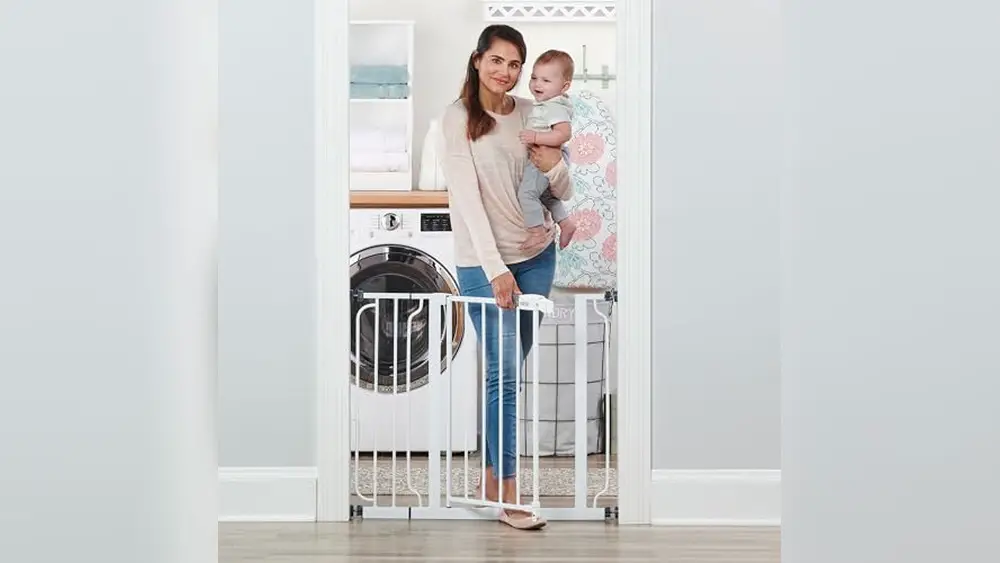
Use painter’s tape to mark the likely frame line and the arc the door would travel. Stand on each side and imitate how you would open it while holding a food bowl or litter supplies. Test the most cluttered part of the day, such as when a laundry basket sits in the hall. Check that the handle would remain reachable and that the door could open fully without catching on the nearby room door.
A near-full-height gate can make more sense in a hallway with two free mounting faces than in a doorway whose jamb is crowded by hinges, a narrow stop or a thick baseboard. Stand where the cat is likely to wait and look for a path that your sketch missed. Move a nearby chair or low shelf before assessing the height again. The change in layout may matter more than buying a taller model.
For the first few supervised uses, observe how the cat approaches the closed gate and where it pauses. Recheck the latch each time a person goes through. Check whether the side bars or pads have moved, particularly after moving furniture or cleaning the floor around the gate. If the frame shifts, a gap opens or the cat reaches a potential exit route, use a solid door and reassess the location before relying on the gate again.
Compare Amazon and Walmart Listings by Model Number
Use the exact model number to compare the same finish and package. On Walmart, the linked product corresponds to the white Richell 94953. The Amazon link runs a model-number search. Check the seller’s product details to confirm that a result is the same item before comparing its price. Similar photos and a matching name can belong to a different width range, finish or accessory bundle.
Compare the delivered cost to your ZIP code and include a compatible extension only if it is necessary and supported. Check who sells the gate and how returns work after unpacking. A tall steel gate can be cumbersome to repack. Save the listing and verify the model and components when the box arrives. It is easier to resolve a missing part before installing the frame.
If you are still deciding between tension mounting and a different setup, read our pressure-mounted walk-through gate comparison for an example of how extension kits affect fit, then use the cat-specific dimensions above for this decision. The wall-mounted pet gate guide explains another mounting style when the opening can accept hardware.
One Last Fit Check for Shared Hallways
In an older home, measure the opening on both sides of the trim and use a level to see whether each planned mounting face is plumb. Compare the dimensions at several points along that face. If your measurements vary, share the smallest and largest values with the manufacturer and include a photo of the trim. Ask how much flat contact area the hardware needs and whether the published range applies with your baseboards in place. Confirm the available depth as well as the width, especially if a door stop occupies the same space as the mounting pad.
If other people share the home, ask each person to walk through the proposed location before you buy. Someone may need to carry boxes, move a stroller, or open an adjacent closet. Leave space to close the gate fully after each trip. Tell everyone which direction it opens and how the latch engages. A gate that is awkward to close in normal use is a poor fit even when the dimensions on paper work.
Frequently Asked Questions
How tall should a cat gate be?
Choose a height that makes sense for the specific cat and the layout. A shorter gate may divide space under supervision. A taller design with closely spaced vertical bars is worth evaluating for a cat that jumps or climbs. Inspect furniture, trim and gaps before deciding whether a gate is practical.
Will the Richell 94953 fit a 33-inch opening?
Thirty-three inches is inside the published stock width range. Measure at the actual mounting surfaces and check the frame height, baseboards, mounting surfaces and door swing against the manual. Confirm any irregular surfaces with the manufacturer.
Can I use a cat gate if my cat is heavier than 11 pounds?
For this Richell model, ask the manufacturer about a product suited to your cat’s size. Also consider the cat’s climbing and jumping habits, since weight alone cannot tell you whether a particular doorway barrier will work.
Where should I check for gaps after installation?
Start beside both jambs and below the door, then inspect between the bars and at the top. Look for the broadest opening the cat can actually reach. If you find a route, follow the manufacturer’s instructions to adjust the setup or use another barrier.
Is an extra tall cat gate useful for introductions?
It may give you a way to manage a supervised view between rooms if the animals cannot pass through or reach each other. Keep a solid door available for full separation and give both animals room to move away. If either animal rushes the barrier or tries to scale it, end the session and close the door.
Before choosing a listing, check three details one more time: the width between the mounting surfaces, the available frame height, and the largest reachable gap after assembly. If you settle on a model, mark its door swing and match your measurements against the manufacturer’s manual. Those checks are easier to do at home than after a large package arrives.