

Affiliate disclosure: As an Amazon Associate, PetPotLuck earns from qualifying purchases. Amazon buttons open search results. Confirm the exact model, variant and instructions before ordering.
A wood pet gate that fits your home starts with the right mounting method
Quick answer: Choose the installation type first, measure the real opening and check whether the barrier suits your pet’s behavior. Freestanding panels are a different purchase from a fixed doorway gate. Appearance alone cannot establish containment or stair suitability.
Compare folding wood gatesSearch Diamond Mesh optionsInterior room boundary or a mounted doorway?
Include angled panels, feet and nearby doors.
Pushing, climbing and chewing change the choice.
Width, height and mounting are model-specific.
Choose a wood pet gate by placement first
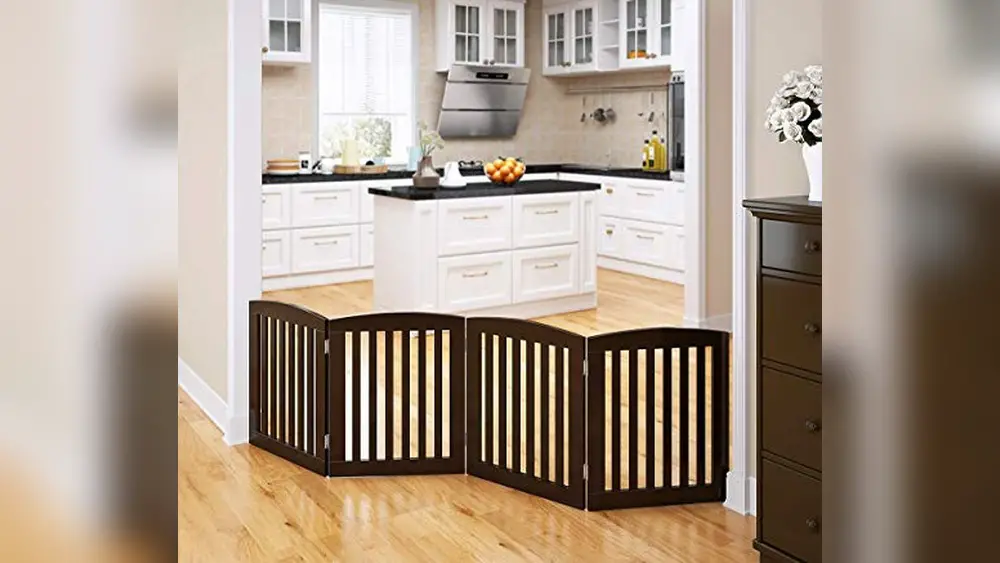
A wood pet gate can make an indoor boundary look more at home among furniture, but the finish should be the last part of the decision. Start with where the barrier will stand, what it will attach to and how your pet behaves around boundaries. A folding room divider and a mounted doorway gate solve different problems even when both have wooden frames.
This guide separates those buying routes so you can compare suitable products before looking at colors or prices. It is a research-based buying guide, not a hands-on test or a promise that a particular gate will contain every animal. There are no invented ratings or fixed marketplace prices here.
Freestanding, pressure-mounted or hardware-mounted?
A freestanding gate relies on its approved layout and floor footprint rather than being attached across a doorway. It can be useful as a movable indoor boundary for a pet that respects it. It should not be treated as a fixed safety barrier, and a determined animal may push it, go around it or jump over it.
A pressure-mounted gate uses an adjustment system between suitable surfaces. Check the manual for cups, fixings and location restrictions; a no-drill headline does not explain every requirement. A hardware-mounted gate uses specified brackets and fixings. For the top of stairs, select a hardware-mounted product explicitly approved for that placement and follow its instructions. Never put a freestanding or pressure-mounted barrier there.
Three practical buying routes
For a movable room boundary, compare folding wooden panels by their working footprint, hinge arrangement and storage size. Do not assume the advertised unfolded length equals the opening you can reliably cover. Angling panels uses some of that length, and support feet can project into the walking route.
For an ordinary doorway, compare a documented pressure-mounted wood-and-mesh model with a suitable mounted alternative. North States lists its Diamond Mesh Wood Gate at 26.5–42 inches wide and 23 inches high. Those figures identify a particular model, not every gate sold under the brand. Confirm the item number and current manual before ordering.
For an unusual opening, request a made-to-measure plan or move the boundary to a more suitable location. A custom finish is useful only after the support, gaps and latch have been planned. Our custom pet gate guide explains what to put in a measuring and quotation brief.

| Design | Compare first | Important limit |
|---|---|---|
| Freestanding folding panels | Approved footprint and support feet | Can be moved or challenged by a pet |
| Pressure-mounted wood frame | Exact width range and contact surfaces | Not for the top of stairs |
| Hardware-mounted design | Fixings, structure and approved location | Installation requirements vary |
| Custom wood gate | Approved drawing, gaps and latch | Check order and installation terms |
Measure more than the doorway width
Record the opening at the floor, middle and proposed upper contact points. Keep all three readings if they differ. Baseboards, decorative trim and uneven walls can make the mounting space different from the width you measure in the center of the doorway. Photograph the contact areas before contacting a supplier.
For a freestanding design, mark the full proposed footprint on the floor with removable tape. Include feet, angled panels and the route people need to use around it. Open nearby doors and cupboards while the outline is in place. If the layout only works when the gate is stretched flat, ask the manufacturer whether that arrangement is approved.
Match the barrier to your pet’s behavior
Body size is only one part of the choice. A quiet dog that stops at a visual boundary presents a different challenge from a dog that paws, climbs, chews or pushes. Watch how your pet responds to existing boundaries and use that information when comparing designs. Do not choose a gate solely because its photograph shows a dog of a similar breed.
Check side gaps, bottom clearance and spaces between bars or mesh for the smallest animal that can approach it. Puppies grow and behavior can change. A taller frame does not automatically address chewing, and a heavier panel does not prove resistance to pushing. If a gate is being repeatedly challenged, reassess the containment arrangement instead of relying on it unchanged.
Wood construction and finish: what to ask
A listing may describe solid wood, engineered wood, a wooden frame with mesh or a mixed-material product. Ask which parts use which material if it matters to your purchase. An attractive woodgrain photograph does not establish construction, coating composition or resistance to damage. Keep the actual specification with the model number in your comparison notes.
Avoid treating “natural,” “non-painted” or “eco-friendly” as proof that a product is safe to chew. Follow the maker’s guidance, inspect for damage and stop use if loose pieces or splinters appear. If an animal persistently mouths the barrier, discuss another material or boundary arrangement rather than applying an unapproved coating or deterrent.
Check the walking route and latch
A gate may fit the opening while leaving an awkward passage for people. Ask for clear walk-through width, not just the outside frame measurement. Consider the bags, laundry baskets and feeding equipment you carry through that doorway. A route that is inconvenient is more likely to be left open or used inconsistently.
Inspect the bottom threshold and door swing on models with a walk-through section. Read how the latch operates and whether a closing feature has specific conditions. A door that swings back toward its frame has not necessarily latched. Household members should understand how to confirm closure without forcing a misaligned mechanism.
Do not turn a room divider into a stair barrier
The installation location matters more than a decorative style label. A freestanding panel near an ordinary room opening is not equivalent to a gate intended to protect a stair edge. Do not infer stair suitability from a marketplace title, a lifestyle photograph or the word “safety.” Read the exact manual and its restrictions.
If children also need protection, select a product explicitly designed for that purpose and placement. A pet gate recommendation does not establish child-safety certification. Avoid improvising with furniture, loose weights or tied panels to create a critical barrier. Ask the manufacturer or a competent installer when the supporting structure is unclear.

Compare the total package before checkout
Write down the brand, model, variant, installation range, height, panel count, mounting system and included accessories. Empty fields are questions to resolve, not details to guess from another listing. A different color or panel count in the same marketplace family may change dimensions or package contents.
Check whether the pictured feet, cups, brackets and extensions are actually included. Use only accessories approved for that exact model. Similar-looking hinges or replacement parts do not establish compatibility. When a seller answers a fit question, save the written clarification alongside the order details so you can check the delivered product against it.
Think about storage and regular cleaning
If the gate will be moved every day, compare its folded dimensions, weight and carrying arrangement. Check whether panels need to be lifted together and whether loose parts have to be stored separately. A compact folded photograph does not tell you how comfortably it can be handled in your hallway.
Plan a storage location where the gate will not fall or obstruct access. Keep hinged panels away from unsupervised play and follow the maker’s folding guidance. Clean according to the finish instructions; soaking a wood component or applying an unsuitable cleaner may damage it. Let the manufacturer’s maintenance guidance determine the cleaning method.
What to inspect when the gate arrives
Before assembly, compare the delivered model and variant with your order. Check the frame, mesh, hinges, latch and supplied hardware for damage or missing pieces. Keep the packaging until you have confirmed that the product and its instructions match the intended opening. Report problems before attempting to compensate for them during installation.
Follow the specified setup sequence and use the approved arrangement. Do not trim a frame, drill extra adjustment holes or force hardware to make an unsuitable size work. Operate any moving door several times without pets nearby, check alignment and confirm the latch behaves as described in the manual. Pause if parts bind or the structure is distorted.
Make the first use a supervised assessment
Introduce the boundary while you can observe your pet. Watch for pushing, squeezing at the sides, chewing and attempts to climb. The purpose is to identify a mismatch before relying on the arrangement for everyday management. Do not leave an animal unattended with a barrier it is actively trying to defeat.
Recheck the setup when it is moved, when the pet grows or when household traffic changes. Investigate changes in stability or closure rather than simply tightening everything harder. Keep instructions and identifying labels available for maintenance questions, replacement parts and any future move to another opening.
When a wood gate is the wrong purchase
A wooden gate may be a poor fit when persistent chewing is already a problem, when an animal repeatedly challenges barriers or when the required support surfaces are unsuitable. A different material may address one concern, but it does not automatically solve mounting or behavior issues. Assess the complete arrangement rather than swapping materials and assuming success.
An unusually narrow doorway or a very wide opening can also make the proposed location impractical. Compare another boundary position before commissioning a complicated workaround. Our narrow pet gate guide covers tight openings, while the Richell Convertible Elite guide discusses a specific multi-panel alternative with its own measurements and limitations.
A simple shortlist that avoids unnecessary purchases
Start with the mounting method and location restrictions. Remove products that fail those requirements before comparing finishes. Then check dimensions, passage width, pet behavior and the delivered package. Two thoroughly documented options are more useful than a long list with missing specifications and repeated marketing claims.
Compare the current total cost only after the fit checks, including any approved accessories and installation work. Read return conditions, especially for assembled or custom products. The cheapest unsuitable gate is still an unnecessary expense, and a more expensive gate is not automatically a better match. Buy the option whose documented use fits your actual home.
Prepare a question for the seller
Send the supplier a short description of the opening, the three width readings and photographs of the support surfaces. Include the pet behavior that concerns you and ask whether the exact model is appropriate. Request a link to the manual, a diagram of the approved setup and confirmation of the included parts. A written answer that identifies the variant is more useful than a general assurance that the gate is sturdy. If important details remain unresolved, keep that option off the shortlist until the manufacturer clarifies them.
More help with measuring and layout
For an unusual opening, use our custom pet gate measuring guide. Tight doorways need their own checks in the narrow pet gate guide. For a specific multi-panel option, see the Richell Convertible Elite buying guide.
Wood pet gate questions
Can I use a freestanding wood gate at the top of stairs?
No. Select a hardware-mounted product explicitly approved for that location and follow its instructions. A movable room divider is not a substitute.
Is a wooden gate chew-proof?
Do not assume so. Inspect for damage and stop use if pieces loosen or splinters appear. Persistent chewing calls for a different arrangement.
Does unfolded length equal usable coverage?
Not necessarily. Angling panels and adding supports changes the footprint. Ask for the approved working layout and coverage.
Will a pressure gate leave no marks?
There is no universal guarantee. The finish, contact points and installation affect the result. Read the model instructions and surface requirements.
Can pet-gate advice establish child safety?
No. For children, choose a product explicitly designed for the intended purpose and location. Check its own documentation.
Ready to compare suitable options?
Keep your opening measurements, preferred mounting method and pet behavior notes beside the listing. Confirm the exact package before checkout.
Compare wood gate optionsSearch the mesh designProduct reference checked October 16, 2026: North States Diamond Mesh Wood Gate specifications. Product images retained from the existing draft are illustrative; verify the current seller’s variant. This guide does not claim hands-on testing, fixed prices or escape-proof performance.