

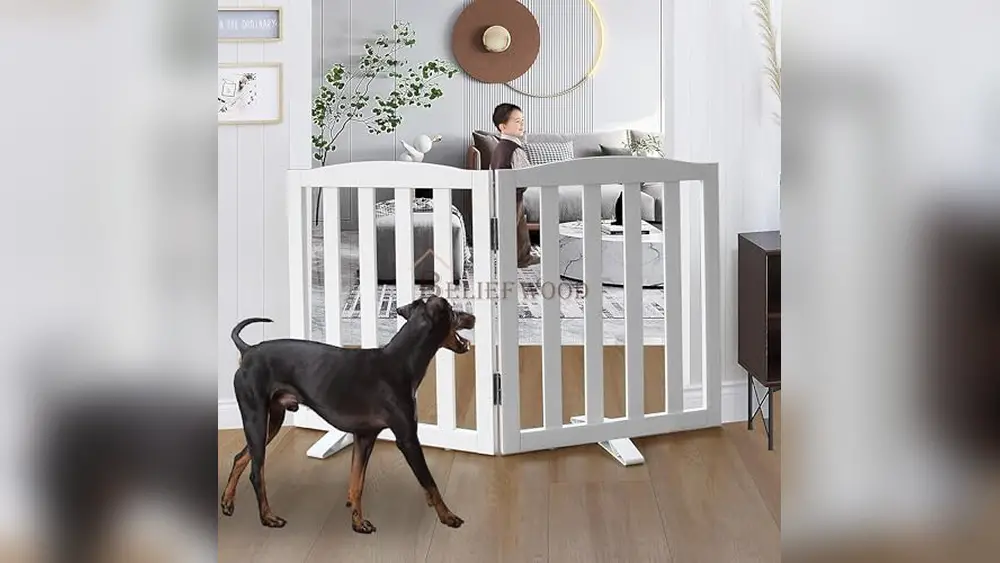
A wooden pet gate for doorway use should fit the opening, leave room for its supports, and suit your dog’s behavior. Start with the doorway measurements rather than the finish. A stylish barrier has little value if your dog can squeeze around its edge or shove it aside.
Affiliate disclosure: As an Amazon Associate, we earn from qualifying purchases. We may also earn a commission through Walmart links, at no extra cost to you.
Quick choice: Compare the Richell Small for narrow entrances, the HL for wider openings, and the Deluxe Medium when a broad entrance needs a walk-through door. These are specification-based selections, not hands-on test results.
Wooden doorway gates: compare fit before price
| Model | Opening width | Height | Footprint depth | Best fit to consider |
|---|---|---|---|---|
| Richell Freestanding Pet Gate Small | 26.4–40.2 in | 20.1 in | 17.7 in | A narrow doorway and a small, calm dog |
| Richell Freestanding Pet Gate HL | 39.4–70.9 in | 27.6 in | 23.6 in | A wider doorway where a low barrier is unsuitable |
| Richell Deluxe Freestanding Pet Gate Medium | 61.8–90.2 in | 28.1 in | 24 in | A broad room entrance where adults need a walk-through door |
Dimensions above are manufacturer specifications for the named models. Retailer variants may differ. Shopping buttons open search results; verify the exact model, size, seller and stock before ordering. We have not verified live prices, so this guide does not declare a cheaper retailer.
Measure your doorway in five steps
1. Measure the clear opening at floor level, above the baseboards and at the planned top of the gate. Record each measurement instead of assuming the sides are parallel.
2. Check the usable floor area on both sides. Freestanding side panels project into the room; the support depth in the table is part of the footprint, not the doorway width.
3. Open the existing room door fully. Check that its swing will not strike the gate, fold a panel or block your own route.
4. Check edge gaps, slat spacing and the gap underneath against your pet’s head and body. If fit is uncertain, ask the manufacturer before use; do not force a pet through a gap to test it.
5. Plan how people will pass. If stepping over creates a trip risk, choose a suitable walk-through design or a different gate type. Do not rely on a low barrier simply because it is easy to cross.
1. Richell Freestanding Pet Gate Small
The Small model is the practical starting point for a narrow room entrance. Richell lists a rubberwood frame, wire slats and folding side panels. Its low height makes crossing easier for some adults, but also makes it a poor match for a dog that jumps. The manufacturer recommends it for dogs weighing 6.5–17.5 lb. Check the 1¼-inch slat spacing against your individual pet; a weight range alone does not establish fit.
Before buying: Confirm the installed opening falls within 26.4–40.2 inches and that you can spare 17.7 inches of support depth. Check the manufacturer specifications and manual.
2. Richell Freestanding Pet Gate HL
The HL offers more height and width than the Small model while retaining a freestanding layout. Richell lists rubberwood construction, rubber feet and folding side panels, with a recommended dog weight of 6.5–33 lb. Its 1¼-inch wire spacing still needs an individual fit check. More height does not make a freestanding gate escape-proof: skip this design if your dog repeatedly pushes, climbs or jumps at barriers.
Before buying: Confirm the installed opening falls within 39.4–70.9 inches and that you can spare 23.6 inches of support depth. Check the manufacturer specifications and manual.
3. Richell Deluxe Freestanding Pet Gate Medium
The Deluxe Medium is the convenience upgrade for a broad opening. Its walk-through door opens in both directions and locks at the top and bottom. Richell lists a 19½-inch door opening, 1¾-inch wire spacing and a recommended dog weight of 8.8–44 lb. Measure carefully: its minimum span is too wide for many ordinary bedroom doorways. The wider slat spacing also deserves special attention with tiny pets.
Before buying: Confirm the installed opening falls within 61.8–90.2 inches and that you can spare 24 inches of support depth. Check the manufacturer specifications and manual.
Freestanding, pressure-mounted or hardware-mounted?
Freestanding wooden gates are convenient for moving a visual boundary between rooms. Their effectiveness depends on the pet respecting the barrier and the gate remaining correctly positioned. Rubber feet can help grip, but they cannot turn a movable gate into an anchored barrier.
A pressure-mounted design may suit an ordinary doorway when its manual permits that installation and the frame provides appropriate contact points. For setup considerations, see our tension pet gate guide. Do not wedge a freestanding gate into a frame and treat it as pressure-mounted.
Where a fall hazard exists, select a gate specifically approved for that location and use its required mounting method. Do not place these freestanding selections at the top of stairs. Pet gates should not be substituted for a child safety gate; choose a separate product approved for that purpose.
Wood finish, chewing and daily care
Check whether a listing describes solid wood, a wood frame with metal infill, or an engineered board. A wood appearance does not tell you how a gate is built. Inspect accessible edges, hinges and feet after assembly and regularly during use.
A dog that chews the frame can damage the finish or expose sharp edges and loose pieces. Remove a damaged gate from service. Follow the model’s cleaning instructions, avoid soaking wooden parts, and check support positions after moving it. These indoor selections should not be assumed weather-resistant.
How to compare Amazon and Walmart fairly
Compare the same model, finish and size at both stores. Then check the delivered total, shipping date, seller, return window and any return-shipping charge. A search result for an extension or replacement panel is not a complete gate. Availability and prices can change between visits.
If a walk-through entrance matters more than a wood finish, also compare our barn door pet gate guide. For a low barrier intended for a calm small dog, see the step over pet gate guide.
Frequently asked questions
Will a wooden gate fit a 30-inch doorway?
The Richell Small’s listed 26.4–40.2-inch range includes 30 inches. You still need to confirm support clearance, individual pet fit and the selected variant. The HL and Deluxe Medium listed here start wider.
Is a taller wooden gate suitable for a jumper?
Height alone cannot establish containment. A determined jumper or climber can make a freestanding barrier unsuitable. Choose a different containment approach if your dog challenges the gate.
Can I use one for a cat?
Do not assume dog-gate dimensions will contain a cat. Cats may jump over, climb or pass through gaps. These selections are not a guarantee of cat containment.
Which should I buy first?
Choose the model whose width and footprint suit the entrance, then consider access and your pet’s behavior. If none fits all three, keep looking rather than buying the closest size.
Sources and selection method
We compared the three linked Richell manufacturer pages for dimensions, configuration and stated pet weight ranges, checked November 4, 2026. Recommendations about convenience and fit are editorial judgments. We did not perform hands-on testing, verify retailer inventory, or assign review scores.