

Affiliate disclosure: As an Amazon Associate, PetPotLuck earns from qualifying purchases. Amazon buttons open search results; check the exact model and size before ordering. This is a research-based buying guide, not a hands-on product test.
Narrow pet gate: measure the opening before choosing a model
A narrow pet gate must fit the actual mounting points, leave a usable walking route and suit the animal you want to manage. The word “narrow” does not describe one standard size. It can also refer to bar spacing, which is a different measurement from doorway width.
Quick answer: Record the opening at the floor, middle and intended upper mounting height. Compare those measurements with the exact variant’s supported range. For a small interior doorway, investigate a documented narrow pressure-mounted model; for a suitable structural fixing location, compare a hardware-mounted design. Never force a wider frame into a smaller opening.
What counts as a narrow pet gate?
There is no useful universal cutoff that makes every gate below a certain width suitable. A compact pressure-mounted frame and an adjustable hardware-mounted panel can solve different problems in the same hallway. Start with the opening rather than a marketing category or the appearance of a product photograph.
A listing can use “narrow” to mean a small installation width, closely spaced vertical bars or a slim profile when stored. Read which one is being described. Narrow bar spacing does not establish that the frame fits a narrow doorway, and a compact frame does not establish that its gaps suit a tiny animal.
This guide focuses on choosing a barrier for an interior opening with limited width. It does not rank gates by unverified strength, claim that any product is escape-proof or treat pet-gate suitability as child-safety certification. If children need protection too, select a product explicitly intended for that purpose and installation location.
Three buying routes to consider
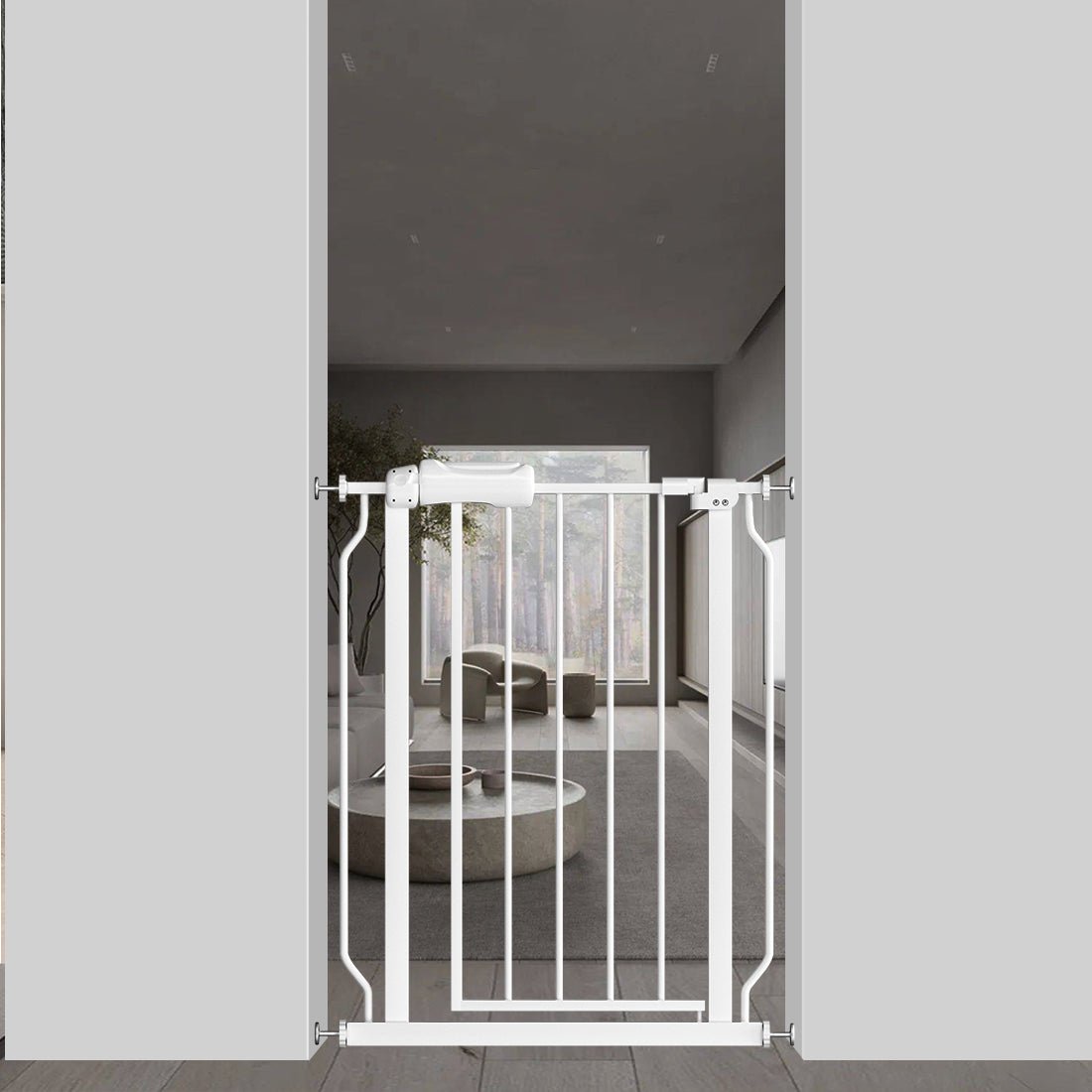
1. A dedicated extra-narrow pressure-mounted gate
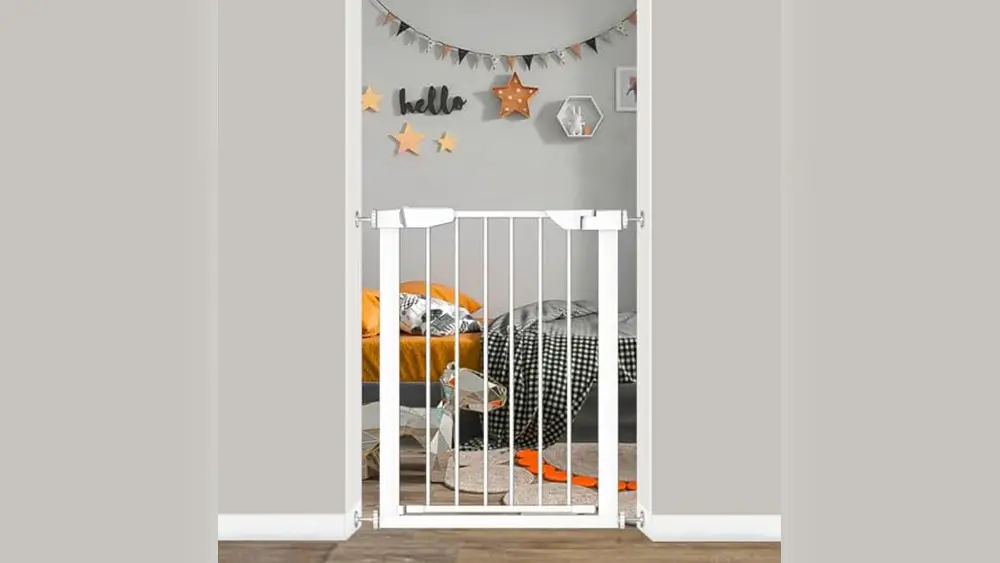
FairyBaby’s official range includes an extra-narrow model; its manufacturer illustration shows a 24.1–26.7-inch width range and a 30-inch height. Treat those figures as belonging to that illustrated variant. Other listings under similar names may cover different widths.
Consider this route: Your measured opening and mounting surfaces match the exact model’s current instructions. Trade-off: A pressure frame can reduce usable passage width and may have a bottom threshold. “No drill” in a title does not establish that every installation accessory is optional.
Before buying, ask for the manual and a package-specific width diagram. Confirm whether the shown dimensions include the adjustment hardware and any supplied cups. If the seller cannot identify the exact variant, keep comparing rather than guessing from a photograph.
2. Cardinal Duragate MG-25: mounted alternative from 26.5 inches
Cardinal lists the MG-25 for openings from 26.5 to 41.5 inches, with a 29.5-inch height and 2.25-inch bar spacing. It is a hardware-mounted model. That makes it a comparison for an opening within its range, not a solution for a 24-inch gap.
Consider this route: Suitable structural mounting is available and the specified dimensions fit. Trade-off: Installation requires the correct fixings, and the bar spacing deserves attention for smaller animals. Do not remove adjustment or mounting components to squeeze it into an undersized opening.
Ask the manufacturer about the exact location and support surfaces if anything is unusual. A general statement about mounting flexibility is not an installation plan for every trim profile, banister or wall material.
3. A custom solution when standard models do not fit
If the opening falls outside documented ranges, request a made-to-measure design or consider another boundary location. A standard gate that almost fits is not a better choice than a properly planned alternative. Avoid improvised shortened frames, mixed-brand extensions and unsupported spacer arrangements.
Use our custom pet gate measuring and quote guide to prepare the brief. Ask the maker to specify the support structure, latch position and clearances in a drawing before ordering.
Compare the options by fit
| Buying route | What to verify first | Main limitation |
|---|---|---|
| Dedicated narrow pressure frame | Exact installation range and cup requirements | Reduced passage and possible bottom threshold |
| MG-25 hardware-mounted gate | 26.5-inch minimum and suitable supports | Does not fit openings below its minimum |
| Made-to-measure gate | Approved drawing and mounting arrangement | Order terms and installation scope need checking |
| Freestanding room boundary | Full floor footprint and pet behavior | Not the same as a fixed doorway installation |
Measure at the points that matter
Take three width measurements: low down, around the middle and near the proposed top. Keep all three numbers rather than assuming the doorway is square. If the sides taper, tell the supplier where the change occurs and ask how its model accommodates that geometry.
Identify what the adjustment hardware will actually contact. A decorative trim edge, painted wall and wooden jamb are different surfaces. Record the material and condition as accurately as possible. Do not count loose trim as a suitable support simply because it is the closest point to the frame.
Measure baseboard height and how far it projects on each side. Photograph the lower corners and upper contact areas. A baseboard can create different spacing at the top and bottom, making a single doorway-width figure misleading. Ask about an approved solution for the exact product instead of building an improvised stack of blocks.
Write the dimensions in one unit system and label them clearly. If a seller provides metric dimensions, convert carefully and keep the original figures beside the conversion. A small rounding difference matters most when you are close to a model’s minimum or maximum installation limit.
Check clear passage, not just gate width
The outside frame width tells you whether the product can occupy the opening. It does not tell you how comfortably a person can walk through it. Ask for the clear door-opening width and inspect where the hinges, latch and fixed side portions sit.
Try the route while carrying the objects you normally carry. Laundry baskets, grocery bags and feeding supplies can make a tight passage more awkward than it appears when you walk through empty-handed. Think about visitors and anyone with mobility needs before choosing a small walk-through design.
Check the threshold and nearby floor transitions. A low bottom bar may be easy to overlook, particularly in dim light. Do not assume that a narrow frame automatically improves accessibility. The door opening, threshold and latch motion should be evaluated as one complete route.
Plan the swing before checkout
Mark the likely door arc with removable tape. Open the existing room door, nearby drawers and cabinets to see what shares that space. A gate can fit when closed yet be inconvenient whenever someone passes through.
Ask whether the exact model swings one way or both ways and whether a direction setting is required for your intended location. Do not borrow the feature list from another width option in the same marketplace family. Different variants can use different frames and hardware.
Consider where the open gate will rest. It should not create a new obstacle in a frequently used corridor. If the layout depends on people stepping over the frame, reconsider the product or boundary location. Everyday convenience affects whether everyone uses the gate consistently.
Pressure mounting and hardware mounting
Pressure-mounted designs depend on the product’s adjustment system and supporting surfaces. Hardware-mounted designs use specified fixings and brackets. Neither label tells you every installation requirement. Read the actual instructions, including how wall cups, anchors and mounting points are treated.
“No drill” should not be read as a promise of no marks, no maintenance or suitability for every wall finish. Ask about the exact surface you have and any required protective or supporting accessories. Get permission for permanent fixings where needed, and select a design that fits those constraints.
Do not put a pressure-mounted gate at the top of stairs. For a stair location, choose a hardware-mounted product explicitly approved for that placement and follow its instructions. A listing photograph or an optional kit mentioned for another model is not sufficient approval.
If the opening has unusual angles, weak trim or unclear support, resolve that with the manufacturer or a competent installer before purchase. It is better to reject an unsuitable location early than to force an installation after the packaging has been discarded.
Match bar gaps and height to your pet
Consider the smallest animal that may approach the boundary. A gate selected around an adult dog can present different gaps for a puppy. Assess the spaces at the sides and bottom as well as between the bars, and ask the maker about any uncertainty.
Observe your pet’s behavior around existing barriers. Pushing, climbing, chewing and squeezing are different challenges. Do not choose solely by body weight or assume a taller frame resolves every issue. A strong or persistent animal may need a different containment arrangement.
For mixed cat-and-dog households, be clear about which animal should pass. A small pet door can defeat the intended separation if the excluded dog also fits through it. A tall gate is not a guarantee against an agile cat, and this guide does not promise cat-proof containment.
Auto-close is a convenience, not a completed safety check
Ask the seller how the closing feature works on the exact model. Some products have specific operating conditions or a hold-open position. Read the manual rather than assuming every released door will close and latch from every angle.
During setup, operate the gate several times without animals nearby. Check the latch engagement as instructed and watch for rubbing or misalignment. A door that swings toward its frame has not necessarily locked. If closure changes after installation, investigate the cause instead of closing it harder.
Show household members how the latch operates and what to check after passing through. A convenient mechanism still requires consistent use. Reassess a setup that people frequently leave open because the handle is awkward or the route is too cramped.

Compare sellers and package contents
Keep a short comparison sheet with the brand, item number, installation range, height, clear passage, mounting method and seller. Record whether a manual is available. Empty fields show what you still need to ask; filling them with assumptions hides a buying problem.
Confirm whether cups, fixings and any extensions shown in photographs are included. Ask which accessories are approved for the selected variant. A matching color or thread appearance is not proof of compatibility, and unrelated replacement parts should not be treated as interchangeable.
Read return conditions before ordering, especially if you are close to a size limit. Check whether assembly affects eligibility, who pays return shipping and whether the original packaging is needed. Keep the seller’s written fit clarification with your receipt.
Receiving, installing and maintaining the gate
Inspect the package and parts before beginning assembly. Compare the contents with the manual and report damage or missing components promptly. Do not install a nearly complete product while waiting for an important latch or mounting part.
Follow the specified sequence for the exact model. Avoid substituting a generic tightening method, screw or anchor because it worked on another household project. If the frame looks distorted or the latch is difficult to align, pause and ask support rather than compensating with extra force.
Keep identifying labels and instructions available after installation. Recheck the product according to its maintenance guidance and investigate changes in movement or closure. Clean it using materials compatible with the finish, and keep the operating area clear of items that interfere with the door.
When to choose another boundary
A narrow doorway can be the wrong location even when a product fits. If the gate blocks normal access, lacks suitable support or cannot meet the intended use, consider an adjacent room boundary. Changing the position may produce a more workable plan than buying the smallest frame available.
For a movable room divider, compare the footprint in our Richell Convertible Elite guide. For a retracting entrance barrier, see our front-door retractable gate guide. These options need their own fit checks and should not be treated as universal replacements.
Frequently asked questions
What is the narrowest pet gate I can buy?
Ranges vary by model and variant. Measure the actual opening and compare a current manufacturer diagram. Do not use a category name or an old listing to decide the minimum supported width.
Will a 26.5-inch gate fit a 24-inch opening?
Not if 26.5 inches is its documented minimum installation width. Choose a model explicitly covering the opening or investigate a custom solution. Do not cut or force the frame.
Does narrow bar spacing mean a narrow frame?
No. Bar spacing describes gaps between bars. Installation width describes the opening the entire product can fit. Check both measurements separately.
Are pressure-mounted gates suitable at the top of stairs?
Do not use a pressure-mounted gate there. Select a hardware-mounted model explicitly approved for that placement and install it according to its own instructions.
Can I mix extensions from another brand?
Use only parts approved for the exact gate. Similar-looking pieces do not establish compatibility. Ask the manufacturer before buying replacements or accessories.
Will an auto-close gate always latch?
Do not assume that. Follow the model’s operating conditions and check engagement after passing through. Stop relying on a gate whose latch or alignment is not working correctly.
Choose by the written measurements
Keep your opening measurements and mounting notes beside the listing. Confirm the exact variant before ordering, and leave an unsuitable model off the shortlist even when it looks convenient.
Sources checked October 16, 2026: FairyBaby official range and linked manufacturer illustrations; Cardinal MG-25 specifications. Confirm current manuals and seller terms before purchase. No hands-on experience, fixed prices, star ratings or escape-proof performance is claimed.