

Affiliate disclosure: As an Amazon Associate, we earn from qualifying purchases. Amazon links below open search results, where availability, sellers and variants can change.
QUICK ANSWER • MEASURE BEFORE YOU BUY
Choose a front-door gate by mounting layout, not just width
A retractable pet gate can provide an extra boundary near an entrance, but mesh is not a guarantee against escape. First decide whether you need a gate across a fixed hallway opening or a barrier attached to the moving door. Those are different products with different clearance needs.
Search Retract-A-Gate on AmazonSearch Bow Wow Barrier on Amazon
Check the exact model, mounting guide and opening dimensions before ordering. These are comparison starting points, not hands-on performance rankings.
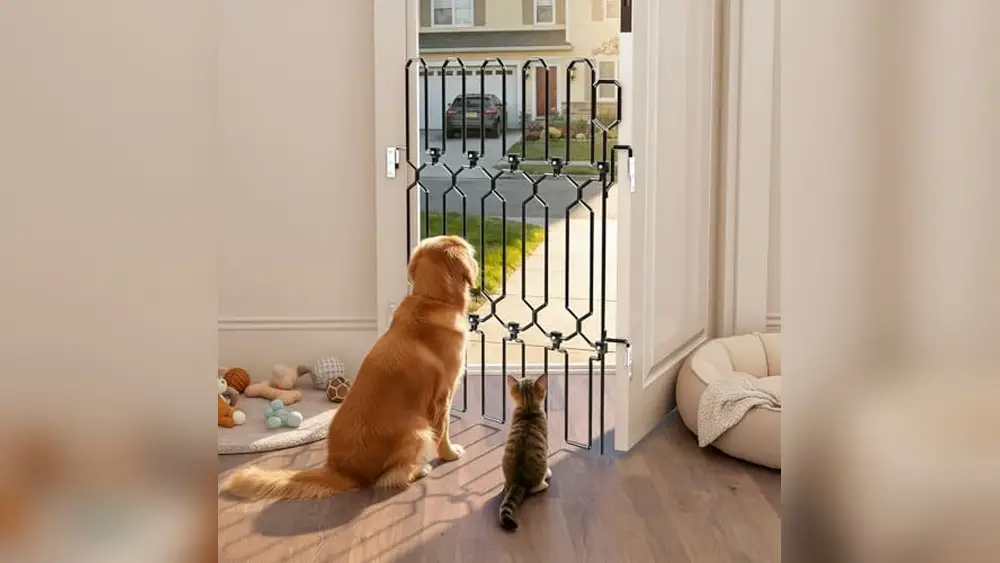
The right retractable pet gate for a front door depends on what happens when that door opens. A dog waiting quietly behind a hall boundary presents a different problem from a dog that rushes visitors. A compact reel can keep a passage clear between uses, yet the convenience only helps when the mounting surfaces, household routine and dog’s behavior suit the product.
This guide compares two layouts from Smart Retract, explains the measurements to record and gives you a practical checkout checklist. We reviewed the manufacturer’s specifications and user guides. We have not installed these products in your home or tested them with your pet. There is no universal best gate for every entryway.
A gate spans two stationary mounting surfaces.
A door-attached barrier changes extension as the door moves.
Check the substrate, brackets and baseboard clearance.
Mesh may be unsuitable for chewing, climbing or forceful pushing.
Two layouts worth comparing
| Option | Manufacturer-listed dimensions | Useful comparison | Main limitation |
|---|---|---|---|
| Retract-A-Gate | Up to 52 or 72 inches wide, depending on model; 34-inch mesh | A fixed entry hall or doorway boundary | Requires compatible hardware mounting and deliberate locking |
| Bow Wow Barrier | Approximately 28-inch extension; 34-inch mesh | A barrier that moves with an exterior door | Extension limit affects usable door opening; this is not the same as a 28-inch door width rating |
Retract-A-Gate: compare for a fixed entryway boundary
This layout places the barrier between stationary surfaces. It may suit a hall behind the front door, where the gate can remain closed while someone handles a delivery. Compare the reel location with furniture, trim and the route people use to enter.
Its two width options do not remove the need to measure. The manufacturer explains that mounting inside an opening and mounting around its outside affect how the brackets contribute to the covered distance. Use the current guide for the configuration you intend to install.

Bow Wow Barrier: compare for a door-attached layout
The Bow Wow Barrier connects the moving door and the adjacent mounting area. Its user guide describes the mesh extending and retracting as the door moves. That can be useful for a brief doorstep interaction, provided the geometry and your pet’s behavior are suitable.
Measure the actual distance between the proposed attachment points at the opening angle you need. Do not assume that a product’s extension specification describes the nominal width of your door. Check that every person using the entrance can understand and manage the barrier before treating it as part of the household routine.
Decide whether mesh is appropriate before measuring
Watch what your dog does around existing barriers while the exterior door stays closed. Does the dog wait, paw at the material, chew, jump or try to push underneath? A gate that looks tidy in a product photo can be a poor choice for a dog that persistently challenges boundaries.
For a dog that has already escaped a mesh barrier, do not buy another simply because it is taller or more expensive. Consider a different containment arrangement and qualified behavior help. Keep the dog away from the open entrance while you assess options. A closed interior room may be more appropriate during deliveries than an unproven new barrier.
Cats and mixed-pet households need their own assessment. A gate selected around one dog’s behavior may offer little separation for a climbing cat or a much smaller animal. Do not translate a product’s marketing photo into a promise about your animals. Check the intended use, then supervise the initial introduction with the exterior door closed.
Measure the full entryway, not only the clear opening
Start by drawing a simple plan of the entrance on paper. Mark the door hinges, handle, trim, nearby walls and the proposed gate line. Add the door’s swing path. This helps reveal a reel that would interfere with the door or a latch that would be awkward behind a cabinet.
Record the distance between the actual mounting points at the top and bottom of the proposed barrier. A sloped floor, thick baseboard or uneven trim can make those distances differ. Write down the usable flat area for each bracket rather than counting decorative molding as a secure mounting surface.
Next, note the floor finish and transitions. A raised threshold or rug near the gate can affect the gap underneath or interfere with operation. Follow the model’s specified positioning; do not raise the mesh simply to clear an obstacle without confirming that the resulting installation is allowed.
Finally, consider people carrying groceries, a stroller or mobility equipment. Leave enough space to operate both barriers without awkward twisting. The best location on a diagram is not useful if someone routinely leaves it open because it is inconvenient. Rehearse the route before drilling.
Check the door swing and delivery routine
A fixed hall gate can create a small buffer area between the dog and the exterior door. Whether that is workable depends on the depth of the hall. You should be able to close the pet boundary, open the front door and handle an item without squeezing into the barrier or relying on the dog to remain still.
A door-attached barrier has a different tradeoff: the usable door angle becomes part of its operation. Check the manufacturer’s extension limit against the exact bracket-to-bracket distance, including any offset. Do not pull the door farther to make room for a parcel if doing so would overstretch the barrier.
Plan for people arriving from outside as well as leaving. Visitors may not recognize a mesh gate or know which latch to use. Explain the routine to household members and caregivers. A note near the entrance can help, but it should support a clear process rather than compensate for an unsuitable layout.
Mounting surfaces, baseboards and drilling
Read the complete current installation guide before choosing tools or hardware. Different doors and walls have different internal construction. The visible finish alone does not tell you where a screw will hold. If you cannot identify a suitable mounting substrate, ask the manufacturer or a competent installer before proceeding.
Baseboards are a common source of misalignment. A lower bracket may sit farther out than an upper bracket, leaving the reel tilted or the handle poorly aligned. Use only accessories approved for the product and follow their instructions. Do not improvise a stack of loose scraps to make an uneven wall appear square.
The Bow Wow Barrier guide distinguishes door-side and wall-side hardware. Treat that as model-specific information, not a general recipe for every retractable gate. Do not reuse an installation video for a similar-looking product if the supplied brackets, screws or mounting points differ.
Renters should get permission for the intended holes and understand the repair obligations before buying. Adhesive-only mounting is not an equivalent substitute for specified screw mounting. If drilling is not possible, compare a different barrier type and its limitations rather than converting a hardware-mounted design without approval.

A practical installation and first-use checklist
- Confirm that the product and all accessories match the current instruction booklet.
- Inspect the mesh, reel, handle, brackets and supplied hardware before mounting.
- Check mounting locations against the floor, trim and full door swing.
- Install exactly as directed; resolve uncertainty about the substrate before drilling.
- Operate the gate several times with the pet away and exterior door closed.
- Check the lock, connections and clearance through the permitted range of movement.
- Introduce the dog gradually under supervision, without using the open front door as a test.
- Stop using the setup if the dog can bypass it or any component moves, loosens or becomes damaged.
Do not deliberately ask a dog to crash into the mesh to prove the installation. Manufacturer testing claims do not describe every wall, every mounting error or every animal’s behavior. A product specification should help you assess suitability, not encourage a stress test at the entrance.
Build a calm door-opening routine
Practice the household sequence when nobody is waiting outside. Move the dog behind the boundary, secure it, then check that the dog is settled before touching the exterior handle. Keep initial practice simple and reward calm behavior. If the dog becomes increasingly distressed or forceful, stop and change the plan.
For a busy home, decide who controls the door and who manages the pet. Avoid two people assuming the other has checked the gate. Children and visitors should not become responsible for testing a new containment arrangement. Make the routine easy to explain and repeat.
A gate is one part of management. It cannot replace training, supervision or a secure exterior door. If your concern includes serious escape behavior, aggression at the doorway or separation-related distress, seek help that addresses that problem rather than relying on a shopping upgrade alone.
Cleaning, inspection and replacement
Follow the care instructions for the actual product. Remove accumulated hair and debris without introducing unapproved lubricants or solvents into the reel. Let cleaned material dry as directed before putting the gate back into its regular routine.
Check for fraying, tears, loose brackets, cracked parts and changes in how the handle engages. Also inspect after a pet has pushed or caught something on the barrier. A gate that suddenly retracts differently or needs extra force deserves attention before the next delivery.
Do not keep using damaged mesh because the reel still operates. Contact the maker about suitable replacement parts and whether repair is supported. Unapproved patches, altered brackets or missing hardware can change the way the system behaves. Keep the model details and guide accessible for future checks.
What to compare before checkout
Compare the exact model, width option, included hardware and return terms. A listing image may show accessories that are not part of the box. Read the variant description, check the seller and ask about compatibility if the installation area is unusual.
Account for approved spacers or additional brackets in the total purchase. Avoid comparing only the gate price when one layout requires extra work. Also consider whether the product can be returned after opening or installation; do not assume that drilling and trial fitting are risk-free shopping steps.
The Amazon buttons here are labeled as searches because we have not matched a stable current product listing to every variant. Search results can include unrelated products. Confirm the brand and model yourself and compare the selected listing with the manufacturer’s documentation before buying.
Related guides for a different boundary problem
If you are comparing a movable rigid barrier, see our Richell freestanding pet gate guide. For outdoor walks after you leave home, our strong-puller leash guide covers a separate equipment decision.
Frequently asked questions
Can a retractable gate replace the front door?
No. Treat it as an additional interior boundary or a model-specific door barrier. It is not a security door or a guarantee that a pet cannot escape.
Is a 72-inch gate suitable for every 72-inch opening?
Not automatically. Check how the manufacturer defines the covered width and whether your brackets are inside or outside the opening. Mounting space and alignment still matter.
Can I fit a retractable gate without drilling?
Only if the exact product supports that method. Do not replace required screws with adhesive or tension mounting. Compare another product if your property cannot accept the specified hardware.
Will a mesh gate stop a large dog?
Size alone cannot answer that. Chewing, climbing, pushing, mounting quality and the particular gate all matter. If your dog defeats the barrier, discontinue that setup rather than relying on supervision from a distance.
Should I step over the mesh?
Use the intended opening method. The Bow Wow Barrier guide specifically says not to step over or crawl under it. Follow the instructions for any other model you choose.
Why is my gate interfering with the door?
Check reel placement, bracket offsets, trim, floor transitions and the permitted swing path against the installation guide. Do not force either the door or reel to compensate for a fit problem.
Make the layout decision first
Choose a fixed opening or door-attached layout, confirm the measurements and mounting surface, then compare the correct model. Keep shopping secondary to a workable door routine and your pet’s actual behavior.