

Affiliate disclosure: As an Amazon Associate I earn from qualifying purchases. Purchases through our links may earn us a commission at no extra cost to you.
Quick answer: match the handle and hardware to your walk
For a nearby traffic handle: compare the Max and Neo 6-foot Double Handle leash. For a rope leash with a locking connection: compare the Ruffwear Knot-a-Leash Large.
A leash does not teach loose-leash walking or guarantee control. Choose a secure, well-fitting walking setup and a reward-based training plan. If you cannot safely manage your dog, get qualified help before changing equipment.
Check Max and Neo details on AmazonCheck Ruffwear Knot-a-Leash on AmazonThe best dog leash for strong pullers is a leash you can comfortably hold, inspect and use with a suitable harness or collar. For many owners comparing everyday options, a fixed-length leash offers a straightforward starting point. Decide whether you need a second handle for brief close positioning or prefer a simple rope design with a locking clip.
Strong pulling creates a handling problem that shopping alone cannot solve. Your dog’s size, movement, triggers and walking environment all affect the choice. A narrow path, a busy crossing and a quiet open area call for different amounts of room. The right equipment should support a manageable routine rather than encourage you to test its limits.
This guide compares two researched options, explains other leash types and walks through length, grip, hardware and maintenance checks. It preserves the useful buying questions from the earlier draft while removing unsupported rankings and promises of injury prevention. We have not load-tested these leashes or used them with your dog.
How we selected these two options
We checked manufacturer descriptions for Max and Neo’s 6-foot Double Handle leash and Ruffwear’s Knot-a-Leash, then matched the named Amazon listings. The linked Max and Neo listing is the black 6-foot version; the Ruffwear listing is the Large, Obsidian Black version. Confirm the selected variant before checkout because sizes, colors and hardware generations can differ.
These are use-case recommendations, not a tested strength ranking. We do not claim that either product is unbreakable, chew-proof, rust-proof or suitable for every dog. We have not compared failure rates or measured shock reduction. We leave out current prices and review scores because those can change and do not establish that a leash fits your handling needs.
| Option | Documented distinction | Consider it for | Tradeoff |
|---|---|---|---|
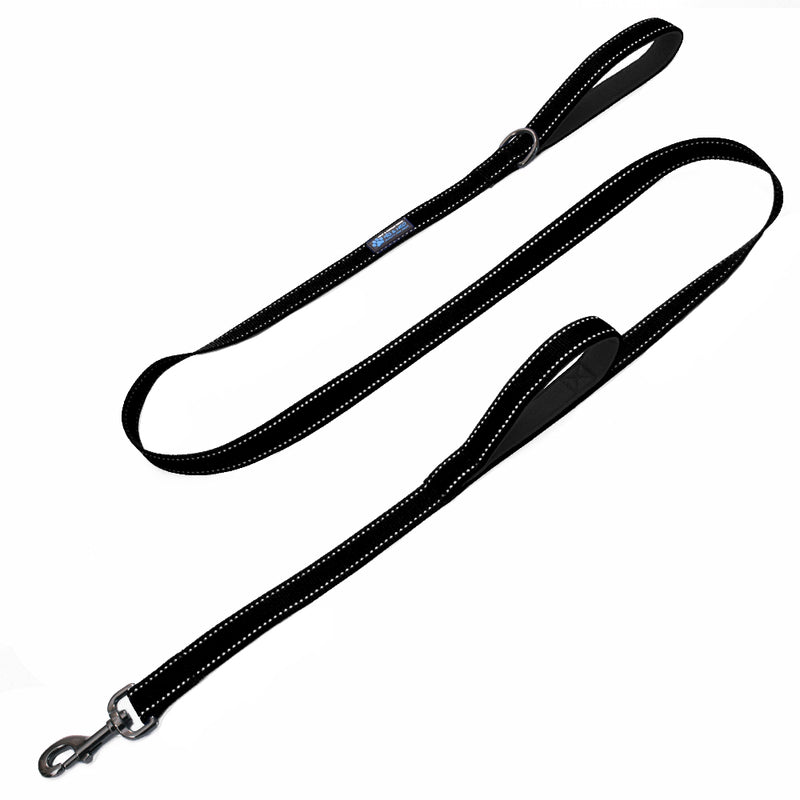
| Max and Neo Double Handle | 6 ft × 1″ nylon; padded secondary handle 18″ from clasp | Owners who want a reachable close-positioning handle | Secondary handle position must suit handler and dog height |
| Ruffwear Knot-a-Leash Large | 5 ft rope; 11 mm diameter; locking carabiner | Owners who prefer rope and a locking attachment | Check the exact hardware generation and practice operating it |
Max and Neo Double Handle: a traffic-handle option
The manufacturer describes two padded handles and reflective stitching. Its nearby handle is the main reason to compare this design with a simple single-handle leash.
Best fit: brief closer positioning on an everyday walk. Limitation: using the lower handle should not require bending awkwardly or keeping constant tension.
View Max and Neo 6-foot listingA second handle can reduce the need to gather a loose length of leash when you want your dog closer for a moment. Think about approaching a crossing, stepping aside for another walker or moving through a doorway. It is a handling feature, not a substitute for keeping an appropriate distance from situations your dog cannot manage.
Check reach before making the traffic handle your main reason to buy. A tall handler with a smaller dog may find a low handle uncomfortable to hold, while another combination may feel natural. A short connection that continually lifts the leash upward can change how you walk. Choose a usable arrangement rather than assuming the second handle improves every situation.
The reflective stitching is a feature to consider for walks in changing light, but it is not a visibility guarantee. Plan your route, use appropriate lighting and stay aware of vehicles and bicycles. A leash can only be one part of that setup. Do not let a reflective description encourage a crossing or location you would otherwise avoid.
If you already use a suitable fixed leash and only occasionally need a shorter hold, compare this feature with your existing routine. Buying another leash is most useful when it solves a specific grip or length problem. The manufacturer’s donation program may matter to you, but the equipment still needs to match your dog and the way you handle it.

Ruffwear Knot-a-Leash Large: rope and locking hardware
This is the rope option in the comparison. The linked listing identifies a 5-foot Large leash with an 11 mm rope diameter.
Best fit: owners who prefer a rope feel and a locking attachment. Limitation: locking hardware still requires inspection and correct closure.
View Ruffwear Large variantCompare the rope diameter with what you find comfortable to hold. Thick material can feel substantial, but more thickness is not automatically easier for smaller hands. Handle shape and the way you gather spare length also matter. You should be able to maintain a comfortable hold without relying on wrapping the lead tightly around fingers.
Practice opening, attaching and checking the carabiner before your first walk. Ruffwear’s current product information describes an auto-locking swivel design; older stock or another variant may use different hardware. Inspect the version in the listing and the product you receive. Never assume a familiar brand name means the closure works exactly like your previous leash.
A rope leash is not a bungee just because it resembles climbing equipment. We do not recommend it on a claim that it absorbs enough force to protect joints or prevent neck injury. Use it for its actual construction and connection features. A comfortable walking setup depends on fit, handling and training as well as the leash.
Five feet is a defined length to assess, not a universal ideal. Check where your dog walks relative to you and whether the route allows that spacing. If you need an additional close-positioning handle, this simple rope arrangement may not be the feature match you want. Compare the two designs by the problem you are trying to solve.
Choose length for the environment
Start with the areas where you walk most often. A fixed leash in the range represented by these two products can allow some room while keeping length predictable. You still need to manage slack and surroundings. More length can let a dog reach another person, a road edge or an obstacle before you react.
A short hold is useful only when it leaves enough comfortable space between dog and handler. Look at dog height, your posture and the attachment point. Do not assume that a very short leash gives better walking manners. Continuous tightness can turn the entire walk into a strained position rather than helping the dog learn the desired behavior.
For a quiet training area, a longer line serves a different purpose from an everyday walking leash. Treat it as a separate equipment decision with its own handling requirements. Do not buy a long line as a quick fix for lunging around traffic. Choose enough distance from triggers and work at a level your dog can manage.
Inspect clips, stitching and the attachment point
Look for complete stitching, intact material and a closure that operates as the manufacturer intends. Inspect the clip where it meets the leash and where it attaches to the harness or collar. A strong-looking strap cannot compensate for a damaged connector or a poorly secured attachment ring.
Check that the clip is compatible with the ring you use. It should close fully without material or another ring interfering with the gate. If the attachment is difficult to operate when you are calm indoors, address that before using it near a road. Do not wait until the dog is excited to discover that the hardware is awkward.
Recheck the whole setup before walks, especially after wet, sandy or muddy outings. Watch for fraying, loose stitching, cracks, deformation or a sticky gate. Replace equipment that is damaged or no longer works properly. Do not treat a heavy-duty label or a previous uneventful walk as evidence that a damaged leash remains safe.
Check grip without relying on an injury promise
Padded handles can change how a leash feels, but comfort depends on your hands, the force applied and the time you use it. No padding makes a sudden lunge harmless. Compare the shape, opening size and the way the strap sits in your hand. Choose something manageable in the conditions you actually encounter.
Avoid winding spare leash tightly around your hand or fingers. Think through how you will gather length, change hands and keep the line from crossing your legs. If your dog’s movement regularly knocks you off balance, stop treating that as a minor comfort issue. Get help with the walking plan and handling setup.
Practice with the dog calm and in a suitable enclosed area before trying a different grip outside. Make sure you can keep a secure hold while opening a gate or reaching for a reward. A bag clip or accessory ring should not become the point you depend on to restrain the dog.
Bungee leashes: understand the tradeoff
A stretch section changes the relationship between your hand position and the dog’s position. That may feel different from fixed webbing or rope. It also means the dog can move farther as the section extends. Consider both the relaxed and extended lengths before selecting a product for a narrow or busy route.
We do not treat bungee construction as a medical benefit or a way to make an unsafe lunge safe. Product claims about shock reduction need their own evidence and do not establish that the setup suits you. If you want to compare a bungee, do so for its handling characteristics and follow the model’s instructions.
For a dog that can suddenly reach traffic, another animal or a passerby, predictable spacing may matter more than elasticity. Choose a route with enough room, work on behavior and assess the whole attachment system. Do not test the maximum extension around a hazard to see whether the leash will hold.
Hands-free, retractable and dual-dog designs
A waist attachment transfers pulling force to your body. It does not remove that force or ensure balance. If you are currently struggling to control one dog with a handheld leash, a hands-free purchase should not be the automatic next step. Assess the dog’s behavior, your movement and the manufacturer’s intended use first.
Retractable leashes add variable range and a locking mechanism. They require a separate handling decision from the fixed designs here. This guide does not make an exception for a retractable product simply because it is marketed for large dogs. If predictable distance is essential to your walk, choose equipment and a setting that support it.
Couplers for two dogs combine their movements at one connection. Two strong pullers can have different speeds, triggers and directional changes. A swivel does not make those movements easy to manage. Consider separate walks or individual training before buying a splitter, and do not claim that a no-tangle feature guarantees control.
Chain leashes also deserve a separate assessment. A dog that bites the leash has a behavior and handling problem to understand, not merely a material to defeat. Do not assume a metal lead is the only answer or encourage the dog to chew it. Discuss persistent leash biting with a qualified reward-based trainer.
The harness or collar still matters
The leash attaches to equipment on the dog, so its fit is part of the decision. Check that the harness or collar is correctly sized, secure and appropriate for the planned activity. Follow the manufacturer’s fitting instructions. Do not use a stronger leash to compensate for an attachment that the dog can slip out of.
Front and back harness attachment points can change how a setup handles. A front attachment is not a promise that pulling disappears. It may require a different leash route to avoid tangling around legs. Observe movement and comfort, and get fitting help if the gear twists, restricts movement or rubs.
If a dog coughs, shows discomfort or has a health issue affecting walks, contact a veterinarian for advice on suitable activity and equipment. This guide does not diagnose a problem or prescribe a particular attachment for a medical condition. A product description about neck or joint protection should not replace that assessment.
Use reward-based training alongside the equipment
The American Veterinary Society of Animal Behavior recommends reward-based methods for teaching skills and addressing unwanted behavior. A leash recommendation should support that approach rather than promise that forceful corrections will solve pulling. Avoid using the lead to deliver painful jerks or punish a dog for reacting.
Work in an environment where your dog can notice you and respond. Reward the behavior you want, such as walking with a comfortable amount of slack. Keep sessions manageable and increase distractions gradually with appropriate guidance. There is no single training timetable for every dog, and buying a particular leash does not establish how quickly progress will occur.
If lunging, fear or aggressive behavior makes walks unsafe, seek qualified professional help and involve your veterinarian where appropriate. Manage distance and exposure instead of repeatedly putting the dog into a situation they cannot handle. Equipment is one part of a plan; it does not replace an assessment of the behavior.
Cleaning, storage and replacement
Follow the specific product’s care instructions. Do not assume the handle padding, rope and hardware tolerate the same washing method. Remove dirt that interferes with the closure and let equipment dry as directed. Avoid harsh chemicals or improvised treatments unless the manufacturer supports them.
Store the leash where the dog cannot chew it and where you can see its condition before the next walk. A leash left loose beside a bored dog may become damaged without an obvious incident outdoors. Check the parts that are hidden by padding or protective covers when the instructions permit inspection.
Keep the model information and any care guidance. If the hardware changes feel or stitching begins to separate, replace or seek manufacturer guidance before another walk. Do not repair a load-bearing section with tape or a household knot and assume the original performance has been restored.
What to compare before checkout
Read the exact variant description: length, width or diameter, number of handles and closure type. Check whether the photos show the size you selected. A brand may sell a traffic leash, a slip lead and an ordinary lead with similar colors. Product-family familiarity is not enough to confirm that you are ordering the intended design.
Review the seller, delivery and return terms, and check whether the product supplied is a current or previous version. We have not verified a universal load rating for these recommendations, so we do not invent one. If your use requires a documented limit or a specific connector, ask the manufacturer before ordering.
Compare cost after confirming the feature match. A more expensive leash is not automatically a better choice, and a bargain is poor value if the handle is awkward or the attachment is unsuitable. Avoid buying on an exaggerated “ultimate control” promise. Choose a practical feature you can identify and explain.
A simple first-walk checklist
Before leaving, inspect the strap or rope, operate the closure and verify the harness or collar fit. Choose a route that gives you room to step away from distractions. Keep the first outing with new equipment short enough to observe grip and movement without turning it into a test of strength.
During the walk, notice whether the line crosses the dog’s legs, whether the secondary handle is reachable and whether you are maintaining an uncomfortable posture. Stop in a suitable place to reassess if the arrangement feels wrong. Do not continue because the product was recommended for strong pullers.
Afterward, check for wear or rubbing and note what actually worked. A good purchase should make the routine clearer and more manageable, but pulling may still require training. If the main problem remains unchanged, revisit the walking plan rather than moving through a long list of increasingly forceful products.
Related buying guides
For households with several walkers, agree on the same attachment checks and how the leash will be held. Show each person how the particular clip works before handing over an excited dog. A traffic handle, locking carabiner or unfamiliar length should not be introduced through trial and error at a doorway. Keep the walking plan consistent, and make sure any caregiver can safely manage the dog in the intended setting. If one person cannot, arrange another option rather than assuming better hardware will make the situation manageable.
For the other half of the walking setup, see our large-dog harness comparison. For supervised enrichment at home, our dog chew-toy guide addresses a separate need. If you use remote check-ins while arranging care, read our treat-camera plan and fit guide. These products serve different purposes and do not replace walking or behavior support.
Frequently asked questions
Will a stronger leash stop pulling?
No. It is equipment, not a training method. Use a suitable walking setup and reward-based guidance.
Which option has a traffic handle?
The Max and Neo 6-foot Double Handle model has a secondary handle. Check whether its position is comfortable for your dog and your height.
Does rope mean shock absorption?
No. Do not assume a rope leash is a bungee or provides medical protection against a lunge.
Is a locking clip impossible to open accidentally?
No such guarantee is made here. Operate it correctly, check closure and inspect for wear or damage.
Should I use hands-free equipment with a strong puller?
Assess behavior and balance first. A waist attachment transfers force to the handler rather than removing it.
Can two strong pullers share a coupler?
Do not assume it is manageable. Separate walks and individual training may be a better starting point.
When should a leash be replaced?
Stop using it when material, stitching or hardware is damaged or no longer functions correctly. Follow the manufacturer’s guidance.
Final choice: buy for the feature you need
Compare Max and Neo for a nearby secondary handle, or Ruffwear Knot-a-Leash Large for a rope design with locking hardware. Confirm the variant, inspect the full walking setup and keep training separate from product claims.
Compare Max and Neo on AmazonCompare Ruffwear on AmazonSources and methodology
Research checked October 14, 2026: Max and Neo manufacturer specifications, Ruffwear Knot-a-Leash information, the exact Amazon listings linked above, and AVSAB humane-training guidance. Product descriptions are not independent testing. The recommendations are editorial judgments about features and use cases, with no invented hands-on experience or performance guarantee.