

Affiliate disclosure: As an Amazon Associate, PetPotLuck earns from qualifying purchases. Product information checked October 15, 2026. This is a research-based buying guide, not a hands-on test or veterinary exercise prescription.
The best dog treadmill for home use starts with the running deck
Choose a dog treadmill by usable belt length, comfortable low-speed operation and the space needed to supervise it. A high weight capacity does not prove that a long-bodied dog has room to move naturally. Remote controls and preset workouts come after those basic checks.
Quick answer: Lifepro PawRunner is a compact model worth comparing for a dog whose movement fits its published 38.2 × 14.2-inch running surface. Longer-striding dogs need a longer-deck shortlist. Before purchasing, ask your veterinarian or a qualified canine rehabilitation professional whether treadmill exercise suits your dog.
View Lifepro PawRunner on AmazonCompare longer-deck dog treadmills
Our recommendation: compare three buying routes
Dog treadmills are expensive, bulky purchases. A list of similar marketplace products can hide the questions that actually decide whether a machine belongs in your home. Start by comparing a documented compact model, a longer-deck dog-specific machine and the option of delaying purchase until your dog has tried one with professional guidance.
Models without sufficient supporting documentation are not included as ranked recommendations here. We have not measured noise, tested motors or evaluated long-term reliability. Where a specification is unavailable or conflicting, ask the manufacturer for written confirmation instead of treating a marketplace headline as a fit guarantee.
1. Lifepro PawRunner: compact model to investigate

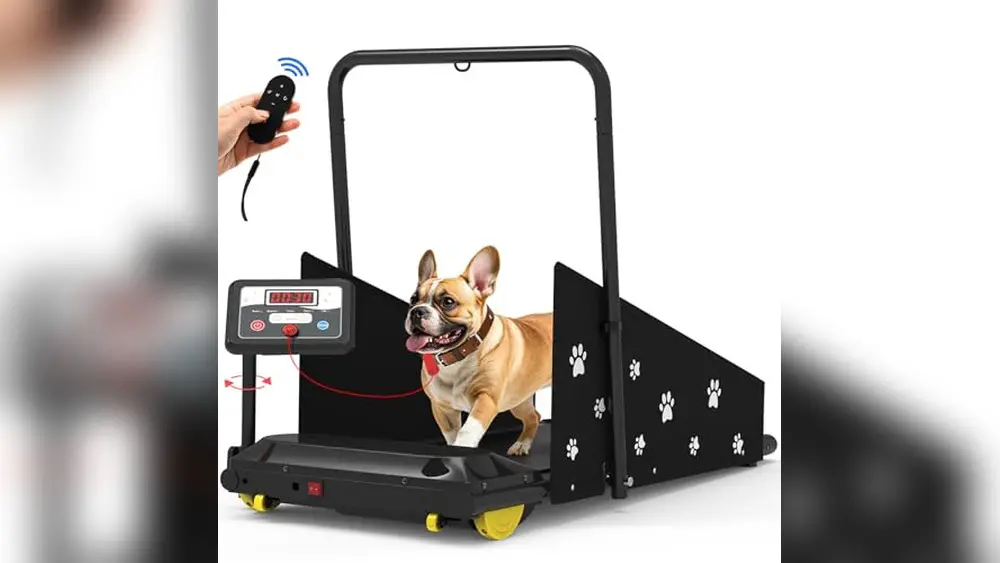
Lifepro publishes a running surface of 38.2 inches long and 14.2 inches wide. The product includes a remote and side panels. Its listed speed range begins at 0.5 mph and extends to 7.5 mph. These are equipment specifications, not recommended exercise speeds for your dog.
Consider it if: You need a relatively compact machine and have confirmed that its deck accommodates your dog’s movement. Skip it if: Your dog’s stride needs more room, or its lowest setting is unsuitable for the introduction plan.
The manufacturer distinguishes recommended pet weight from maximum capacity in its graphics. Ask Lifepro which limits apply to the exact unit sold by your chosen seller, including body length. Do not use the larger capacity number alone to decide fit.
2. Longer-deck dog treadmills: for a larger movement envelope
A longer dog-specific machine is the next comparison when a compact belt is too short. Request the actual usable running area and current manual before placing an order. “Large dog” in a listing is a category label; it is not a substitute for measurements.
Consider this route if: Your dog needs more fore-and-aft room and you have enough permanent floor space. Trade-off: A bigger machine can be harder to deliver, assemble, clean around and return. Check whether a folding claim refers to the entire unit or only one component.
3. A supervised trial before buying
If your dog is worried by machinery or has never encountered a moving belt, a professional introduction can answer questions that reviews cannot. Ask a qualified canine rehabilitation service about an assessment or supervised trial before committing to equipment that may be costly to ship back.
Consider this route if: You are unsure about suitability, movement or willingness. Trade-off: Availability varies by location, and an appointment adds time. The useful result may be a better equipment brief, another activity plan or a decision not to buy.
Compare the buying decisions
| Option | Main attraction | Question before buying |
|---|---|---|
| Lifepro PawRunner | Published compact belt size; remote | Does the deck fit your dog’s movement? |
| Longer-deck dog machine | More space for longer strides | Are belt dimensions and clearances documented? |
| Professional trial | Checks suitability before purchase | What assessment is available locally? |
| Existing human treadmill | No new machine purchase | Has a professional confirmed suitability? |
| Non-motorized slatmill | Different operating mechanism | Do you understand braking and handling requirements? |
How to check running-deck fit
Separate three measurements in every listing: usable belt dimensions, assembled frame dimensions and storage dimensions. They answer different questions. The belt is where your dog moves. The assembled dimensions determine whether the machine fits the room. Storage dimensions matter only when the unit is packed away as instructed.
Cornell’s veterinary guidance emphasizes an appropriate treadmill length for the dog and movement being performed. It notes that many human treadmills are too short for a large dog’s stride. Ask a professional to assess movement rather than relying on your dog’s standing footprint or a breed label.
Build a written comparison sheet with one row per exact model. Enter usable belt length and width, lowest speed, weight limits, manual link and seller. Leave unknown fields blank and request the missing information. A clear gap in the sheet is more useful than a guessed number copied between similar listings.
Photographs help identify controls and side-panel layout, but do not demonstrate fit for your dog. Camera angles, the animal’s position and the pace shown can change the impression of available room. Do not approve a compact machine simply because a promotional photo includes a large breed.
Measure your home before ordering
Mark the assembled footprint on the floor with removable tape. Add the clearances required by the exact manual, keeping the handler’s position and access to controls in mind. A space that holds the frame tightly between furniture may still be unsuitable for operation.
Walk the delivery route from the entrance to the planned room. Check doorway widths, stairs, corners and the assembly location. Ask whether delivery is to the curb, entrance or room of choice. A machine that is easy to buy online can still be difficult to move after a large carton arrives.
Think about the room during normal household activity. Children, other pets and visitors should not pass through the operating area. A calm room with a clear route is easier to manage than a busy hallway. Keep the location accessible enough that operation does not require moving half the furniture first.
Read electrical requirements before purchase. Follow the manufacturer’s instructions for the outlet, cord routing and any permitted accessories. Avoid a trip route with the power cable. If the room cannot meet the specified setup, resolve that before the return window begins.
Controls and stopping features to inspect
Ask the seller to show the control panel clearly. Identify how the belt starts, how speed changes and how it stops. Find out whether a program changes pace automatically and whether straightforward manual operation is available. An impressive program count adds little if basic controls are confusing.
Check the emergency-stop system in the current manual. Know which parts are included and how the manufacturer says to test them. Do not confuse an emergency-stop clip with a restraint for holding the dog on the machine. Ask the professional guiding your introduction how handling equipment should be used.
A remote can make a control easier to reach, but introduces another item to maintain. Confirm whether the main console remains usable without it and how replacement remotes are obtained. Treat connectivity as a convenience rather than a reason to overlook a poorly documented deck.
Side panels deserve a close look. Check their attachment method and whether replacements are sold. Panels are not permission to leave the dog alone. The operating arrangement must let the supervising person observe the dog and respond promptly.
Noise claims: ask for useful evidence
“Quiet” and “silent” are difficult to compare across listings. Ask whether a stated sound level was measured under load, at what distance and at which speed. Without context, two numbers may not describe comparable conditions.
Consider your home as well as the motor. A room above a downstairs neighbor, hard flooring and loose nearby objects can create different practical problems. Ask about approved floor protection and placement instructions. Do not add an improvised platform to solve vibration without confirming that the setup remains suitable.
If sound is a major concern for your dog, prioritize an appropriate introduction and workable return policy. A short video cannot tell you whether your dog will accept the equipment. Learn about acceptance before purchase instead of assuming a quiet-sounding advertisement guarantees comfort.
Introduce the equipment without rushing
The American Kennel Club describes gradual, reward-based introduction, beginning with comfortable interaction around a stationary treadmill. It advises against forcing a dog onto the equipment. Movement is a later step, after the dog is comfortable with earlier stages.
Arrange introduction with a qualified professional and follow the exact machine instructions. Do not copy a timed workout from a product page or choose a program because its name sounds appropriate. An initial session is about learning and comfort rather than an advertised distance or calorie target.
Cornell recommends professional assessment and an individual plan, including appropriate harness support and controlled walking or trotting. This guide does not provide a universal speed, duration or incline schedule. A puppy, an older dog and a sporting adult should not be treated as interchangeable users.
Remain present and stop if your dog shows distress, lameness, stumbling or difficulty breathing. Seek veterinary advice for concerning signs rather than trying to finish. A refusal to continue is a reason to reassess, not a target to push through.
What a treadmill cannot replace
A treadmill does not provide a complete daily routine. Outdoor opportunities for sniffing, toileting, exploration and appropriate social contact still need consideration. Plan equipment as one possible part of the routine rather than a way to remove every walk from the calendar.
It is not a substitute for veterinary care or treatment of a behavior problem. Do not assume that more belt time will solve anxiety, destructive behavior or changes in activity. If behavior or exercise tolerance changes, investigate the reason instead of increasing a machine setting.
For outdoor equipment, our leash buying guide for strong pullers explains handling-related purchase choices. A treadmill and leash serve different purposes, and neither should be selected on a promise that a product alone will change behavior.
Ownership costs and return questions
Compare total delivered cost, including assembly service and required accessories. Ask who pays return freight and whether an opened, assembled machine can be returned under current terms. Keep copies of the listing and seller correspondence, especially when several sellers offer what appears to be the same model.
Find out who handles support: the marketplace seller, importer or manufacturer. Ask about replacement belts, safety keys, side panels and remotes. Clear parts availability can matter more than a long feature list if a small component becomes unavailable.
Ask how the warranty applies to the exact seller and region. A badge in a product image does not explain registration requirements, exclusions or shipping responsibility. Read the written terms and retain the serial number, receipt and assembly instructions together.
Maintenance should be manageable in your room. Read cleaning, belt-checking and lubrication instructions before buying. Compare access for those tasks. Never service powered equipment with a pet nearby or ignore the manufacturer’s isolation instructions.
Used machines and similar-looking listings
A used treadmill needs more than a quick power-on demonstration. Ask for the exact model, serial number, original instructions and a description of any repairs. Establish whether all safety components are present and whether the manufacturer still supports that version. A missing part can change the practical cost of a bargain.
On marketplaces, similar photographs do not prove identical construction. Compare model numbers, documents and seller details rather than choosing a machine from its color. If one listing gives several conflicting measurements, request a clarification that separates the running surface from the frame. Keep that answer with your purchase records.
Check the seller’s inspection and reporting process before delivery. Photograph packaging damage and follow the stated procedure promptly. Keep the packaging until the equipment has been checked and the return requirements are clear. This is particularly useful for a large item that may need its original supports for shipping.
A final checklist before checkout
- Professional suitability assessment and realistic introduction plan.
- Exact model, usable deck dimensions and documented limits.
- Room footprint, clearances and delivery access checked.
- Controls and emergency-stop instructions understood.
- Current seller, return freight and warranty responsibility confirmed.
- Replacement parts and maintenance requirements reviewed.
If a check fails, keep comparing rather than buying the closest-looking alternative. The right result may be a larger machine, another room or a different activity. A treadmill is useful only when the complete setup works for the dog and supervising person.
Frequently asked questions
What is the best dog treadmill for home use?
There is no universal winner. PawRunner is a documented compact option to compare, while longer-striding dogs need a longer-deck shortlist. Fit, suitability and operating setup matter more than a broad “best overall” label.
Can a large dog use a compact treadmill?
A capacity claim alone cannot answer that. Compare the usable belt with the dog’s movement and get professional guidance. A dog below a weight limit may still need a longer surface.
Can I leave my dog exercising while I work elsewhere?
No. Stay and actively supervise operation. A remote, camera, side panel or automatic program does not replace someone ready to stop and assist.
Is a human treadmill suitable?
Some setups are unsuitable because of deck dimensions, starting speed or layout. Ask a qualified professional to assess the actual machine and dog rather than assuming existing equipment will work.
How many minutes should my dog use it?
Ask the professional assessing your dog for an individual plan. This guide does not prescribe workout duration or speed. A maximum setting is not an exercise recommendation.
Should I buy a motorized treadmill or slatmill?
They operate differently. Compare controls, braking, handling and training requirements with a qualified professional. A dog-powered design does not eliminate supervision or make every dog a suitable user.
Ready to compare equipment?
Keep belt measurements and operating instructions open while comparing listings. Confirm the current seller and exact variant before ordering.
Sources: Lifepro specifications; Cornell veterinary guidance; AKC introduction guidance. No independent noise measurements, hands-on testing, medical outcomes, star ratings or fixed prices are claimed.