

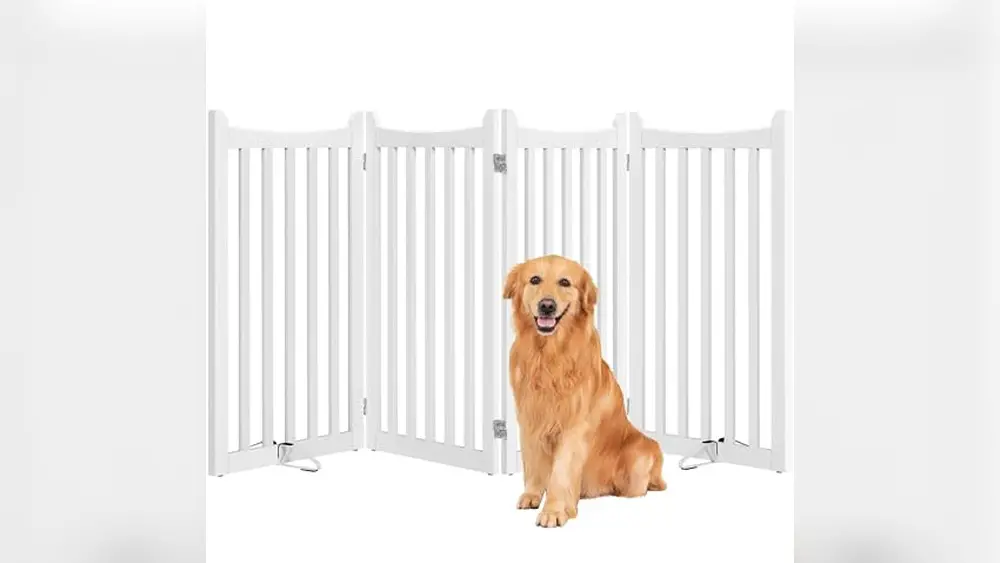
If your freestanding pet gate keeps falling over, check the panel layout, support feet and floor contact before buying a taller replacement. A folding gate stretched nearly straight, a missing foot or an uneven surface can make a movable barrier easier to displace. But if your dog pushes, climbs or jumps at it, a freestanding design may be the wrong type of containment.
Affiliate disclosure: As an Amazon Associate I earn from qualifying purchases. We may also earn a commission from Walmart links, at no extra cost to you.
Use this guide for supervised room boundaries on a level indoor floor. Keep a movable gate away from stair edges, balconies and other fall hazards. Never use a pet gate as a child safety gate.
These links show different options. Match the exact model, dimensions, seller and included parts before comparing checkout totals.How this guide was prepared: We reviewed manufacturer specifications from Yaheetech, PETMAKER and Richell, then organized the checks below around common setup decisions. This is a research-based troubleshooting guide; we have not performed hands-on stability testing or measured a force rating for these gates.
Quick diagnosis: what moves first?
Watch what happens during ordinary use from a safe position, without encouraging your pet to challenge the barrier. Does the entire gate slide, does one end lift, or does a hinge fold inward? Those are different problems. Identifying the first movement helps you decide whether a setup correction is plausible or whether you need another containment method.
| What you notice | Check first | Stop using it when |
|---|---|---|
| Whole gate slides | Floor condition, pads and pet pushing | It cannot maintain the boundary |
| One end rocks or lifts | Level floor, foot placement and panel shape | Required support cannot sit flat |
| Panels fold inward | Hinges, approved layout and locking parts | A hinge or lock is damaged |
| Dog climbs or jumps | Suitability of a movable barrier | The pet attempts to cross it |
| Gate blocks your walking route | Footprint and access needs | You need to step over a tall barrier |
7 checks when a freestanding pet gate keeps falling over
1. Check whether the panels are stretched too straight
A folding barrier needs a layout supported by its own instructions. The maximum length measured with every panel in a straight line is not automatically the opening width it can cover while remaining freestanding. Angling panels takes up some of that length and creates a larger footprint. Do not remove that footprint just to make the gate reach across a wider room.
Start with the manufacturer’s recommended arrangement and measure the covered span after positioning it. If both ends barely reach the walls only when the panels are flattened, choose a different size or approved configuration. A slightly narrower room boundary can be more practical than forcing a long, shallow layout into a space it was not designed to cover.
2. Confirm that every required support foot is fitted
Check the parts list against what is actually installed. Some folding gates have separate support feet; others rely on side panels or another base design. A foot that came in the box is not an optional accessory unless the manual says so. Look for missing hardware, a foot that has rotated or a support that is sitting on the edge of a rug.
Fit the supplied parts only in the locations and orientation shown by the manufacturer. If a foot or fastener is missing, request the correct replacement using the model number. Avoid attaching improvised blocks, weights or straps. They can create new pinch points, trip hazards or attachment problems without establishing that the gate is suitable for your pet.
3. Inspect floor contact and protective pads
With the pet elsewhere, check whether every intended contact point rests on the same level surface. A threshold, thick carpet edge or uneven tile can leave one support partly unsupported. Move the gate to a flat location permitted by its instructions. If there is no suitable level position across that opening, a different gate design may be necessary.
Remove loose hair and debris around the feet and check protective pads for damage or displacement. Clean the floor and gate according to their care instructions, and let surfaces dry before repositioning. Pads may help protect flooring, but they do not convert a freestanding gate into an anchored barrier. Do not assume adding a household nonslip mat establishes safe containment.
4. Check hinges, fasteners and any locking parts
Inspect the gate while it is out of service. Look for cracked panels, bent components, missing screws, loose feet and hinges that no longer hold their intended position. A loose joint can let the shape change when the gate is moved. Follow the maintenance instructions for tightening hardware, taking care not to overtighten fasteners into wood or MDF.
Stop using a damaged gate until the manufacturer confirms an appropriate repair or replacement. Tape, glue and substitute hinge hardware can change how it folds or carries loads. If the model has a walk-through door, check its latch separately. A door that closes properly does not prove the entire freestanding structure will resist a dog leaning against it.
5. Decide whether your pet respects a movable boundary
Consider your dog’s behavior before its weight alone. A quiet dog that remains behind a visual boundary presents a different situation from one that paws, pushes or races toward it. A taller panel does not fix sliding at the base, and a heavier gate does not guarantee that a determined pet cannot move it. There is no universal safe dog size for all freestanding gates.
If your pet repeatedly challenges the barrier, stop relying on it. Discuss an appropriate containment arrangement with the manufacturer and consider a correctly installed mounted gate or another suitable enclosure. Do not run a test by tempting the dog with food on the other side. The useful observation is normal behavior, not a deliberate attempt to make the setup fail.
6. Remove nearby launch points and route conflicts
Look at the room around the barrier. A sofa, chair or low table beside the gate can give a pet another route across the boundary. An opening around the side may be easier to use than the center. Reposition the boundary within the manufacturer’s permitted setup instead of assuming extra height solves every possible escape route.
Also check how people move through the space. A tall gate without a door may need to be folded or moved each time someone passes. That repeated movement can change the panel angles or foot position. If the household keeps stepping over it or shifting it while carrying laundry, choose an access arrangement that fits the route. Our folding pet gate with door guide explains the alternative.
7. Confirm that the location suits freestanding use
A movable room divider is a poor match for a location where displacement could expose a drop or another immediate hazard. Keep freestanding barriers away from stair edges and elevated areas. Product photos and broad marketing descriptions should never override the exact model’s installation restrictions. A listing that mentions stairs does not establish that placing it at the top of a staircase is appropriate.
Do not convert a freestanding gate into a wall-mounted gate with improvised screws or hooks. Use a model expressly designed for the location and follow its mounting requirements. If you are comparing installation types, read our wall mount pet gate guide. The important question is whether the whole system matches the opening, supporting surfaces and animal.
Measure the opening, footprint and gaps before replacing it
Write down more than the distance from one wall to the other. Measure the opening where the gate will actually stand, including any baseboard projections. Then allow floor space for angled panels and feet on both sides of the barrier. A gate can appear narrow in a front-facing photo while extending into the walkway when assembled.
Use removable floor markers outside your pet’s reach to visualize the footprint, then walk through your normal route. Check nearby doors, cabinets and drawers. A support foot should not prevent a door from closing or sit where someone is likely to trip. If you cannot reserve the necessary space, choose a model with a different installation method.
- Record the opening width at the actual gate position.
- Check the manufacturer’s usable opening range, rather than total unfolded panel length.
- Reserve the full depth required for feet and approved panel angles.
- Check side gaps, bottom gaps and spaces between bars for your individual pet.
- Plan how adults will pass without stepping over a tall panel.
- Keep the packaging until you have checked fit under the retailer’s return policy.
Do not check a gap by forcing your pet’s head or body into it. Ask the manufacturer about suitability if dimensions are unclear. Puppies grow, coats can hide body size and two pets in the same household may need different containment arrangements. A setup that works for one animal is not automatically suitable for another.
Two freestanding options to compare after the checks
Replacement makes sense when the gate is damaged, the necessary parts are unavailable or its dimensions do not suit the room. It is less useful when the core problem is a pet that pushes or climbs every movable barrier. The following options illustrate different size choices; neither is presented as a tested solution for a determined escape artist.

Yaheetech 36-inch four-panel gate: The manufacturer lists MDF and iron construction, rotating hinges and two support feet. Its approximately 79.5-inch unfolded length should not be treated as a guaranteed freestanding opening width. This is an option to investigate when you need a taller folding room boundary and have room for its approved footprint. Confirm the configuration before ordering.

PETMAKER 32-inch three-panel gate: The brand distinguishes its 54-inch overall length from a recommended opening range of 33–46 inches. That distinction is useful when checking whether a folded barrier can cover your space. Consider it for a narrower indoor boundary if your pet respects a movable gate. It has no walk-through door in the model discussed here.
Compare the same brand, model, panel count, height and finish when checking prices across stores. Include shipping, taxes, included support parts and return conditions in your decision. We do not display a fixed Amazon-versus-Walmart price winner because listings, sellers and checkout totals change. A lower advertised price is not useful if it buys a different size or omits needed components.
For models with a door and a different base design, see our Richell Premium Plus freestanding pet gate guide. For a broader comparison of materials and shapes, use our wooden freestanding pet gate comparison.
Frequently asked questions
Will a taller freestanding gate stop it falling over?
Height alone does not correct an unsuitable base, missing support or a dog pushing the gate. Identify the first movement and check the approved setup. Choose a different containment method if your pet continues to challenge a correctly configured barrier.
Can I use furniture or weights to hold the gate in place?
Use only supports and attachments approved for the exact model. Furniture, loose weights and homemade straps can introduce gaps or trip hazards. Ask the manufacturer about the intended setup instead of adding an improvised restraint.
Does the maximum panel length equal the doorway width?
Not necessarily. Angled panels and side supports use some of the overall length. Look for a recommended opening range and measure the assembled footprint. Contact the manufacturer when a listing provides only unfolded dimensions.
Can a freestanding pet gate be used for a baby?
Do not use a pet gate as a child safety gate. Choose a child safety product intended for the child’s age and the installation location, and follow its instructions. A pet product’s appearance does not establish child safety suitability.
When should I replace the gate instead of adjusting it?
Replace or retire it when structural parts are damaged, approved replacement components cannot be obtained, the required footprint does not fit or your pet defeats the barrier. An installation problem may be fixable, but an unsuitable design needs a different solution.
Choose the boundary your home can actually support
If your freestanding pet gate keeps falling over, work through the setup with the pet safely elsewhere: approved panel shape, required supports, level contact, sound hardware and a suitable location. Then consider normal pet behavior and daily access. Keep using a movable barrier only when it reliably suits those conditions. If it does not, changing the containment design is more useful than buying extra height.
Manufacturer sources: Yaheetech four-panel gate specifications; PETMAKER three-panel dimensions; Richell Premium Plus specifications and manual link. Product facts checked November 23, 2026. Follow the instructions supplied with your exact model.