

Important: This guide helps you discuss food selection with your veterinarian. It does not prescribe treatment, a therapeutic diet, or supplement doses.
Quick answer: choose food with your veterinarian
A Cushing’s diagnosis does not identify one best bag of dog food. Ask your veterinarian to recommend a feeding plan based on the individual dog, current diet, body condition, test results, and any additional diagnosed problems. Food selection should support that plan, rather than replace treatment or monitoring.
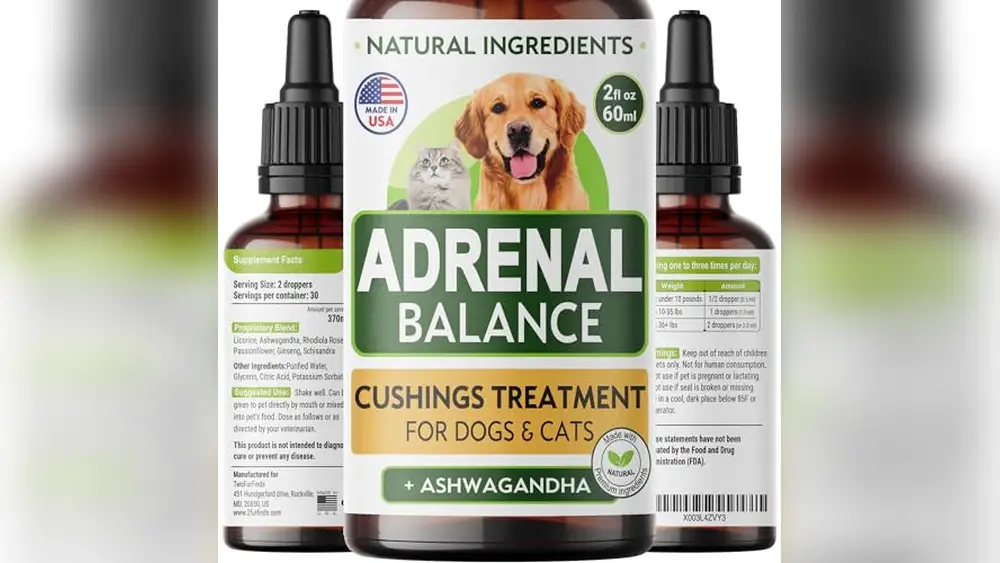
Do not choose a kidney diet, herbal adrenal drops, or a supplement simply because a retailer mentions Cushing’s disease. This page does not recommend any product as a cortisol-lowering treatment. It gives you a practical way to prepare questions, identify the exact food your veterinary team recommends, and avoid confusing shopping claims with medical evidence.
What Cushing’s disease means for this discussion
FDA’s owner guidance explains that Cushing’s disease involves excess cortisol and that treatment depends on the cause and individual circumstances. Medication and veterinary monitoring are important parts of care; some cases involve surgical decisions. Cornell’s veterinary overview likewise describes treatment options and the need to address associated conditions.
Those resources do not establish the supplements formerly promoted here as replacements for veterinary treatment. This article does not select a medicine, dose, procedure, or diagnostic test. If your dog has not been diagnosed, a retailer’s symptom list is not a way to confirm the disease.
Use the diagnosis and instructions from your own veterinary team as the starting point for the food conversation. Keep uncertainty visible: a question about diet is different from a confirmed need for a particular therapeutic formula.
Why there is no product ranking here
A useful recommendation requires a clear match between a product and the dog’s actual needs. We cannot make that match from the phrase Cushing’s disease alone. Listing several bottles with adrenal wording would create the appearance of comparison without demonstrating which option is appropriate.
The previous recommendations mixed supplements and a kidney-care food under a dog-food title. They also made claims about hormone regulation and symptom relief without adequate supporting evidence. Those recommendations and their purchase links have been removed from this guide.
The replacement is a decision process you can use with a professional who knows the dog. We do not claim hands-on testing, veterinary approval of this article, or evidence that a featured product improves treatment outcomes. There is no paid product recommendation in the current version.
Start with the existing feeding plan
Before shopping, write down the complete name of the food currently used, whether it is dry or wet, the package size, and the feeding instructions you follow. Include a photograph of the label. This gives the veterinary team a specific starting point rather than a general statement that your dog eats a certain brand.
Explain why you want to make a change. Availability, storage convenience, a recommendation from the clinic, and a new health concern are different reasons. The reason helps frame the next useful question.
If you already have a written plan, keep it available when comparing products. An online guide should not silently override it. Ask whether the current food should remain in place while you clarify any proposed change.
Bring a complete diet and product history
Prepare a list of everything given alongside the main food: treats, toppers, pill-hiding foods, supplements, and other extras. Include exact product names when you have them. A photograph of each package is often easier to organize than a description from memory.
Keep medicines on a separate list and share both lists with the veterinary team. Do not decide that an item is unimportant because it is sold as natural, available without a prescription, or packaged as a treat. The person directing care needs a clear picture of the routine.
Record what is currently used and what you are only considering. That distinction prevents a proposed purchase from being mistaken for something already being administered.
Ask for specific food-selection instructions
Useful questions are concrete: should the present food continue, is another formula recommended, and what exact product name should you look for? Ask whether the dog’s other diagnosed conditions change the choice. If a clinic gives you a broad category, ask what information you should check on the label.
Request feeding and transition instructions in a form you can refer to later. Clarify who to contact if the recommended product is unavailable. A planned substitute is easier to assess than an unexpected bag selected by a search algorithm.
You do not need to arrive with a confident product ranking. Bring the information you have, identify what remains unknown, and let the clinical recommendation guide the purchasing comparison.
Do not assume kidney-care food is appropriate
A kidney-care label describes a different dietary purpose from a Cushing’s diagnosis. This article does not recommend low protein or low phosphorus for every dog with Cushing’s. It also does not determine whether your dog has kidney disease or requires a renal feeding plan.
If kidney concerns have been raised, ask the veterinarian which confirmed findings guide the food decision. Bring the exact proposed product and its information, rather than assuming that all products labeled kidney support are equivalent.
Availability without a prescription is a purchasing detail, not evidence that professional advice is unnecessary. The same principle applies when a retailer describes a diet as vet formulated. Ask about individual suitability before treating the label as a recommendation for your dog.
Keep food and supplements in separate categories
Complete food, treats, and supplements serve different product roles. A bottle of adrenal drops is not a bag of complete dog food. A product title containing a disease name does not establish that the product treats that disease.
We do not provide supplement doses or recommend adding herbal products to the feeding plan. If you are considering one, show the full label and proposed use to the veterinary team. Include it in the product history even if it was suggested by a friend or a retailer.
If a supplement is already part of your routine, discuss it with the veterinarian rather than changing prescribed treatment on your own. This page does not tell you to stop, replace, or adjust a medicine.
Read claims without treating them as proof
Words such as natural, balance, support, and holistic can sound reassuring, but they do not answer the practical question of whether a product is appropriate for this individual dog. A product description is a claim to evaluate, rather than a clinical conclusion.
Ask what evidence supports the exact claim and whether it concerns the exact product, species, and intended use. An ingredient story, customer review, or attractive before-and-after description does not establish a treatment outcome for your dog.
Keep the label separate from your own observations. If you notice a change while several things are happening, record it for the veterinary team. Do not automatically attribute the change to a new food or supplement and turn that assumption into a treatment decision.
Make a short comparison sheet
Once the veterinarian identifies suitable candidates, give each exact formula a column. Add rows for the full product name, intended use, package size, feeding instructions, unresolved questions, seller, and delivery information. Mark missing fields as unknown.
Add the clinic’s recommendation beside the candidate, with the date and any conditions attached to it. This helps distinguish an approved choice from a product you found while searching. Keep the same formula name throughout the comparison.
If you switch from dry to wet food, or from one recipe to another, update the column rather than copying all the details. A shared brand name or similar photograph does not establish that two products have the same purpose or instructions.
Match the exact retailer listing
Use the full recommended product name when you search. Check recipe, format, package quantity, and variation before ordering. Retailers may display several choices on one page, and a change in bag size or flavor can change the selected item.
Review the final cart rather than relying only on the first photograph. Confirm whether the order is one package, several packages, or a bundle. If the title and label image disagree, resolve the discrepancy with the seller or manufacturer.
Read seller, delivery, and return information at the destination. A listing that appears in a search is not automatically available for your address. Readers outside the United States should confirm the locally sold formula rather than assuming an identical name means identical product information.
Handle an unavailable product deliberately
If the recommended food is unavailable, note the exact formula and contact the clinic about an alternative. Do not substitute another product solely because it has the same brand logo, condition keyword, or package color.
Ask whether an alternate format or package size is acceptable, and whether instructions need to change. Keep that answer with the comparison sheet. This is especially useful when several household members place orders.
Plan reordering around the confirmed product and normal delivery time. A written backup choice, when provided by the veterinary team, is more useful than a last-minute purchase guided by whatever a retailer promotes first.
Compare cost without inventing savings
Check the current total price, package amount, shipping, and selected variation at the retailer. This guide does not display live prices, discounts, or a promise that a particular option is cheapest. A search-result price may refer to a different package.
If you calculate cost per unit of weight, use the same units for both candidates. That calculation describes package cost only. It does not automatically describe the cost per day or clinical suitability.
If cost is a concern, explain it openly to the veterinary team and ask about appropriate alternatives. Compare subscriptions separately from one-time orders, and review product, interval, quantity, and cancellation terms before accepting a recurring arrangement.
Write down the agreed feeding routine
Keep the exact food name and individual feeding instructions together. This article does not provide a universal number of cups, calories, or grams for dogs with Cushing’s. Use the plan supplied by the person directing the dog’s care.
Identify who handles each meal and how portions are measured. A measuring cup or kitchen scale is a tool for following instructions; it does not establish the right portion. Put the instructions where household members can find them.
Include approved extras in the routine so they are not forgotten when discussing the total diet. If someone changes the food or adds an item, update the record and clarify it with the veterinary team.
Keep appointment preparation simple
A short note is usually more useful than a long collection of unrelated shopping screenshots. Bring the current food label, product history, written feeding routine, and the questions you want answered. Identify any information that has changed since the last visit.
Ask what observations the team wants recorded and how they prefer to receive them. Record the date and specific description rather than labeling an observation as a diagnosis. A clear history helps the team interpret the situation.
FDA emphasizes regular veterinary review and blood-test monitoring during treatment. Do not use a new food, an improved appetite, or a retailer testimonial as a reason to skip the follow-up schedule you were given.
Keep care instructions separate from shopping notes
Use one area of your notes for the veterinary care plan and another for ordering information. The care plan includes instructions from the clinic; the ordering notes include package, seller, delivery, and stock details. Mixing them can make a retailer statement look like medical advice.
If the clinic changes a recommendation, update the care-plan note first. Then review any pending order or saved shopping list. Check subscriptions so an old selection does not continue automatically after the intended product changes.
Ask for clarification when two instructions appear to conflict. This guide cannot resolve a disagreement between an individual clinical plan and a package statement. Keep both available for the professional who can assess them.
Check the delivery before using it
Compare the delivered package with the order and recommended formula. Read the name, format, quantity, and identifying information. A familiar logo does not settle whether the shipment contains the intended recipe.
Keep label and lot details available after opening, and follow the package’s storage instructions. If you transfer the food into a container, preserve the information needed to identify the original package.
If the delivery is wrong, damaged, or unclear, contact the seller or manufacturer about the package and the clinic about any effect on the feeding plan. Do not treat an accidental substitution as an approved alternative just because returning it is inconvenient.
Know when to contact the veterinary team
FDA advises contacting your veterinarian right away if you think your dog is experiencing a medication side effect. Treatment can require careful monitoring. This page cannot distinguish a medication problem from a food issue, disease progression, or another condition.
Ask your veterinary team in advance which changes require urgent contact and what number to use outside normal hours. Keep those instructions with the care plan rather than searching a product-review page during a worrying situation.
Do not respond to concerning changes by independently adjusting medication, starting adrenal supplements, or replacing treatment with food. Share the timing, exact products, and observations so the clinician can direct the next step.
Frequently asked questions
What is the best dog food for Cushing’s disease? This page does not establish a universal winner. Ask your veterinarian to identify a suitable feeding plan, then compare the exact products that fit it.
Can herbal adrenal supplements replace treatment? We do not recommend that substitution. The claims formerly used to promote supplements here were not adequately supported. Discuss all products with the veterinarian directing care.
Does every dog with Cushing’s need kidney-care food? This guide does not recommend that assumption. Kidney-related dietary decisions require their own individual assessment.
Should I change protein or phosphorus amounts myself? No targets are prescribed here. Ask for specific instructions rather than applying a nutrient restriction from an unrelated product description.
Are products in a search result verified recommendations? No. Retailer visibility, breed wording, and disease keywords are not evidence of individual suitability.
Has a veterinarian reviewed this article? No veterinary review of this article has been completed. It is an editorial guide to organizing food-selection questions and purchasing information, with disease background linked to authoritative sources.
Sources and editorial review
Disease background was checked on October 3, 2026 against FDA’s owner guidance and Cornell University College of Veterinary Medicine’s overview. These sources are not endorsements of this website or its former product recommendations.
This revision removes unsupported treatment claims and purchase links. It does not rank supplements, promise outcomes, or report feeding trials. Individual diet and treatment decisions remain with your veterinarian.