
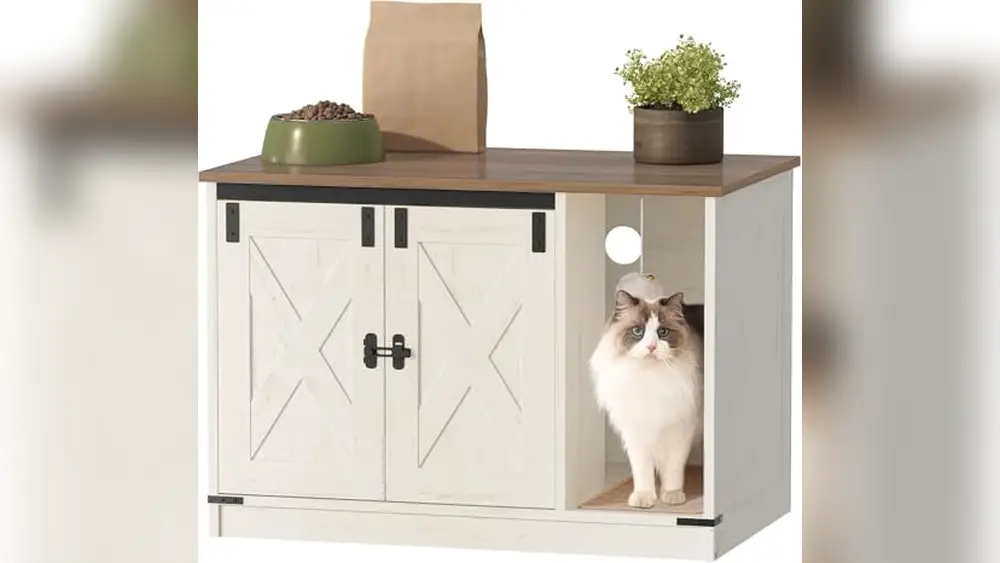
The best hidden cat litter box furniture is the enclosure that accommodates your cat’s comfortable litter pan, makes daily scooping easy, and gives your cat an accessible entrance. A cabinet that looks attractive but forces you to downsize the pan is a poor trade. Start with the litter setup your cat already uses, then choose furniture around it.
This guide compares three different approaches: a composite furniture enclosure, an MDF cabinet with an entrance compartment, and a planter-style litter box. It explains what each design can offer, what to verify before ordering, and when an open litter box is the more practical choice.
Affiliate disclosure: As an Amazon Associate, I earn from qualifying purchases. Amazon links in this article may earn us a commission. Two links lead to Amazon search results because an exact matching product listing has not been confirmed; these are clearly labeled.
Quick choice: choose by fit and cleaning access
- Furniture appearance with a composite shell: consider the NewAgePet Jumbo Litter Loo after confirming its usable interior and your pan’s clearance.
- A cabinet with a separate entrance area: consider the TRIXIE XL enclosure, checking the litter compartment rather than relying on the overall cabinet size.
- A decorative planter instead of a side table: consider the Good Pet Stuff Original, provided its circular litter area and raised opening suit your cat.
None is a universal winner. A large cat, a cat that avoids covered boxes, or a cat with difficulty stepping over an entrance may be better served by an accessible open pan.
View NewAgePet Jumbo Black listing on AmazonCheck the selected size, color, seller, current availability and return terms. This is a product listing, not a promise that your existing pan fits.
Hidden litter box furniture compared
These are design comparisons based on manufacturer information, not hands-on test results or a ranking based on customer ratings. Product names can cover several sizes and kits, so confirm the exact version before buying.
| Option | Design and material | Who may prefer it | Main check before buying |
|---|---|---|---|
| NewAgePet Jumbo Litter Loo | ECOFLEX wood-plastic composite furniture enclosure with a storage shelf. | Owners who want the appearance of a side table around an existing pan. | Usable interior, entrance clearance and pan-removal path. |
| TRIXIE XL, model 40233 | MDF and metal cabinet with an entrance area; entrance can be placed on either side. | Rooms where entry direction and front-door cleaning access matter. | Litter compartment dimensions after accounting for the entrance area. |
| Good Pet Stuff Original | Polypropylene planter-style litter box with a removable top and artificial plant. | Owners who prefer a planter shape and can lift the top for maintenance. | Circular usable space, raised opening and Base versus Essentials kit contents. |
1. NewAgePet Jumbo Litter Loo: a composite furniture enclosure
NewAgePet identifies the Jumbo Litter Loo as an ECOFLEX wood-plastic composite enclosure with a shelf below the tabletop. The manufacturer describes the material as moisture resistant. That is useful to distinguish it from unfinished wood, but it does not establish that the assembled cabinet is waterproof or suitable for leaving spills inside.
Consider it if: you already have a litter pan your cat likes and want a furniture-style enclosure around it. Before ordering, request the usable interior dimensions for the Jumbo version and compare them with the outside dimensions of your pan, including its rim and handles.
Limitations: the cabinet’s external dimensions do not tell you how much turning room remains above and beside the pan. The brand also sells a standard Litter Loo, so a listing photograph or a similar product name is not enough to identify the correct size. Check the selected variant and assembly information.
Think through maintenance as a physical task. Can you reach every corner with your scoop? Can you lift the filled pan out without tipping it against the entrance? Can you wipe the floor underneath? If those movements are awkward, attractive furniture may turn routine cleaning into a chore.
Manufacturer reference: NewAgePet Jumbo Litter Loo.
View NewAgePet Jumbo Black listing on Amazon2. TRIXIE XL: a cabinet with a separate entrance area
The official TRIXIE page lists model 40233 in white, with other model numbers for different colors. It specifies MDF and metal, a litter-catching entrance area, a left- or right-side entrance option, a wide cleaning door and a magnetic closure. MDF is an engineered material; this cabinet should not be described as solid hardwood.
The listed overall dimensions are 29.5 × 20.9 × 20.1 inches. Those are overall cabinet dimensions, not a confirmed litter-pan compartment measurement. The entrance area occupies part of the footprint, so do not compare a long pan against the full external cabinet length.
Consider it if: the entrance direction matters in your room and you want front-door access for scooping. Draw the cabinet footprint on the floor with removable tape, then allow space for the doors to open and for the cat to approach the side entrance.
Limitations: an entrance compartment may help collect some tracked litter, but it cannot guarantee clean floors. It also adds another surface to inspect and wipe. A pan that technically fits may still leave too little space for your cat’s normal entry and turning movements.
Ask for an interior drawing or the assembly guide if the retailer provides only exterior measurements. Match the model number as well as the brand: a different TRIXIE cabinet can have a different layout.
Manufacturer reference: TRIXIE XL enclosure, model 40233.
Search Amazon for TRIXIE 40233 XL enclosureSearch link: results may include other models or sellers. Verify the exact item before ordering.
3. Good Pet Stuff Original: a planter-style litter box
The Good Pet Stuff Original uses a polypropylene litter-box base under a removable planter-shaped top, with an artificial plant and a carbon filter. It is a litter box itself rather than a rectangular cabinet built around any pan you choose.
For the Original version, the manufacturer lists an interior approximately 19 × 19 × 19 inches and an opening approximately 9⅛ inches wide and high, positioned 6¾ inches above the ground. These measurements help identify a possible mismatch, but a circular floor does not provide the same usable corners as a rectangular space of equal width.
Consider it if: you prefer a planter shape, your cat is comfortable with an enclosed space, and lifting off the top for cleaning works in your room.
Limitations: the raised opening may be unsuitable for a cat that needs easier entry. The Original and Courtyard versions differ, and Base and Essentials kits have different contents. Verify whether a removable tray is included. The decorative plant is artificial; keep plant pieces, moss and the filter away from pets that chew them.
The filter is not a substitute for removing waste. You also need somewhere to set the top while scooping without blocking a doorway or resting dirty surfaces on furniture.
Manufacturer reference: Good Pet Stuff Original White Birch.
Search Amazon for Good Pet Stuff OriginalSearch link: confirm Original versus Courtyard, the kit contents and the selected color.
How to measure before buying litter box furniture
Start with the pan, then check the enclosure
Measure the pan your cat comfortably uses. Record its maximum outside length and width, including curved rims, handles and any clips. Measure its height at the tallest point. If it has a hood, decide whether that hood will remain in place; putting a covered box inside a cabinet adds another enclosed layer.
Next, find the cabinet’s usable internal dimensions. Ask whether a divider, hinge, shelf support or door frame intrudes into that space. A retailer’s “large” label is not a measurement, and the amount of room needed depends on the actual pan and cat.
For a hypothetical example, a pan measuring 22 × 16 inches cannot be assessed against a cabinet advertised as 30 inches long without knowing the inside compartment. A separate entry section could occupy part of that length. Even an interior larger than the pan does not automatically establish adequate overhead room or an unobstructed exit.
Check the approach and the cleaning route
Measure the room with the cleaning doors fully open. Leave enough space to kneel or stand, move a scoop and remove the pan. An enclosure that fits between a sofa and wall may still be unusable if its door opens into the sofa.
Also check how the cat reaches the opening. A side entrance placed tightly against a wall can create a cramped approach. Do not use the tabletop as a reason to put the whole unit in a noisy or heavily trafficked spot. The furniture needs to work as a toilet location before it works as decor.
Account for your cat’s needs
A kitten, a senior cat or a cat with limited mobility may need a lower entrance. A large cat needs room to turn and adopt a normal toileting posture. Watch how your cat uses its present box rather than choosing a cabinet from a staged product photo.
AAHA guidance notes that accessibility, box size and open-versus-covered preferences matter. If an enclosure compromises those needs, keep the open box. New house-soiling or signs of discomfort warrant veterinary advice rather than assuming a different cabinet will solve the problem.
Materials, spills and cleaning: what to look for
Compare the material description with the way the furniture will be used. MDF, solid wood, coated panels, plastic and wood-plastic composites have different care requirements. A painted finish does not automatically make joints or exposed edges resistant to repeated wetting.
For any cabinet, look for surfaces you can reach and seams you can inspect. Urine or spilled litter hidden under a pan will not become easier to clean because the doors conceal it. If you use a protective mat, make sure it lies flat, does not prevent the door from closing and can be removed without scattering litter.
Read the product’s care instructions before using cleaning chemicals. Do not soak an assembled cabinet unless its instructions specifically permit that treatment. Dry cleaned surfaces before replacing the pan, and check edges and hardware for damage during regular maintenance.
A helpful shopping test is to mentally rehearse a complete litter change: open the enclosure, remove the pan or tray, empty it, clean the relevant surfaces, dry them, refill and reassemble. Identify where each part will rest. If the process requires moving heavy furniture every time, reconsider the layout.
Storage is another practical detail. A shelf can hold supplies, but make sure a stored scoop or litter bag does not obstruct ventilation openings or the cat’s entrance. Keep cleaning products safely out of reach. Confirm any tabletop load limit before using the enclosure as a side table.
Does hidden furniture control litter odor?
Hiding a litter box changes what you see; it does not remove the source of odor. Doors can make the room look tidier while making it harder to notice a dirty pan. Inspect inside the enclosure rather than relying only on how the surrounding room smells.
Scoop daily and keep up with the litter and pan manufacturer’s maintenance instructions. Check for spills outside the pan. A vent, filter or moisture-resistant panel may be a useful design feature, but none supports a blanket promise of an odor-free home.
Choose a location with normal room airflow and avoid covering the enclosure’s designed openings. Do not add fragrances simply to disguise an unpleasant interior. If odor keeps returning despite cleaning, inspect the pan, cabinet seams and nearby floor before purchasing another accessory.
For litter-related buying considerations, see our cat litter odor-control guide. Furniture selection and litter selection address different parts of the setup.
Introducing an enclosure without forcing the change
Make changes gradually where practical. Set up the furniture with an accessible entrance and retain a familiar litter option during the transition. Avoid changing the enclosure, litter type and location at the same time; otherwise it becomes harder to identify which change your cat dislikes.
Observe actual use. Is your cat entering freely, turning comfortably and leaving without hesitation? Is waste staying in the pan? Are you still cleaning as regularly as before? Those observations are more useful than assuming acceptance because the cabinet has a cat-shaped opening.
If your cat avoids the enclosure, provide a comfortable alternative and reassess the design. Do not block access to the familiar box or punish accidents. In multicat homes, one decorative cabinet should not replace access to multiple litter locations; AAHA recommends a box for each cat plus an additional box as a rule of thumb.
For a different approach, our automatic litter box guide discusses self-cleaning designs. Do not assume an automatic unit can go inside ordinary furniture: check its manufacturer’s requirements for clearance, sensors, airflow, access and power routing first.
Frequently asked questions
Can I use any cabinet as litter box furniture?
Not automatically. A cabinet needs a suitable entry, sufficient usable room and a cleaning route. Cutting an opening does not establish safe access, ventilation or spill resistance. Purpose-built furniture still needs the same fit checks.
Is a hidden box better than an open box?
It may suit your decor, but it is only a good choice if your cat uses it comfortably and maintenance remains easy. Keep an open option when your cat prefers it or the enclosure is too restrictive.
Will a litter-catching entrance stop tracking?
It can provide another surface for loose litter to fall onto, but results depend on the litter, cat and layout. Treat it as an area to clean, not a guarantee that litter will stay inside.
What should I check on an Amazon listing?
Confirm the exact model, size, material, interior measurements, included components and return terms. Search results can mix similar names and unrelated products. Match the manufacturer’s specifications rather than buying solely from the first image.
Final buying checklist
- Your cat’s current comfortable pan fits the usable compartment without sacrificing necessary room.
- The entrance height, width and approach suit your cat.
- You can scoop, remove the pan and clean hidden surfaces easily.
- You understand the material’s care requirements and the exact kit contents.
- The room layout allows both cat access and fully opened cleaning doors.
Choose the enclosure that meets those checks. If none does, an accessible open pan is a sensible result of the comparison, and you can improve the surrounding room without compromising the litter setup.
Sources and editorial approach
This guide uses manufacturer descriptions to identify materials and design features, and veterinary guidance for litter-box considerations. We have not personally tested these products. Prices, ratings, seller claims and stock status are not presented as fixed facts.